Bid & Tender Writing
Bid or No Bid? A Simple Decision Checklist for Small Suppliers
Assess profitability, capacity, competition, requirements and strategic fit before committing to a tender, with a practical decision checklist.
A good tender opportunity is one you can deliver well, at a sustainable price, with a credible reason for the buyer to choose you. A large headline contract value is only the beginning of that assessment.
For a small supplier, preparing a bid uses time that could otherwise go into paid work, customer care or developing the business. Before opening a blank response document, decide whether this particular opportunity deserves that investment.
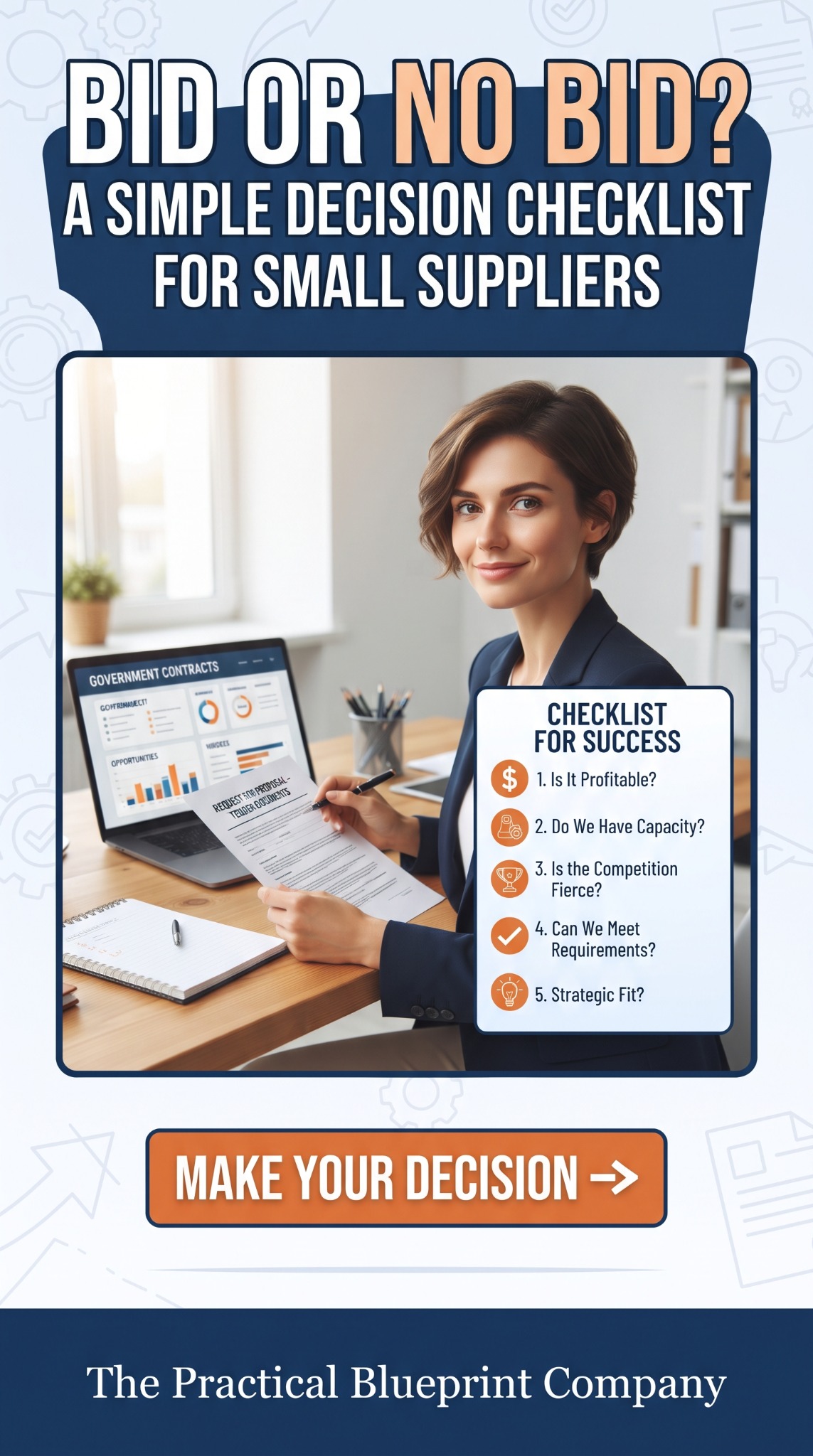
The five questions on our pin give you a useful starting point: is it profitable, do you have capacity, how strong is your competitive position, can you meet the requirements, and does the work fit your plans? This guide turns those questions into a practical decision.
Start with three possible answers
You do not have to jump straight from “interesting” to “we are bidding”. Use three outcomes:
- Bid: The opportunity is workable, and you can commit the people and time needed.
- Clarify first: A specific unanswered question could change the decision.
- No bid: A significant obstacle cannot be resolved, or a better use of your resources is available.
Give a “clarify first” decision an owner and a deadline. Otherwise, it can become a half-started bid that consumes evenings without anyone agreeing to proceed.
The Home Office’s SME/VCSE Bid Pack recommends making an evidence-based bid/no-bid decision before committing resources. The working checklist below is our practical planning approach, not a buyer’s official scoring system.
Want a repeatable tendering process? Our Win More Contracts: Small Business Bid & Tender Writing Blueprint includes tools for qualifying opportunities, organising evidence and preparing responses.
Check the non-negotiables before scoring the opportunity
Read the notice, instructions, specification, evaluation criteria, pricing schedule and proposed contract. A search result or email summary is not enough to support the decision.
Look for requirements that could prevent you from proceeding: a deadline you cannot meet, an essential capability you cannot supply, an unacceptable contractual commitment or a delivery area you cannot cover. Identify what must be in place at submission and what may be required later.
Do not reject yourself simply because a requirement is unfamiliar. Check the wording and ask a clarification question where needed. Equally, do not assume a mandatory requirement will be waived because the rest of your response is strong.
For public procurements, rules and procedures vary. Current government supplier-selection guidance, for example, distinguishes demonstrating that required insurance can be obtained after award from already holding it before award, with exceptions for insurance independently required by law. Check the applicable documents and clarification response before treating an insurance gap as an automatic rejection.
1. Is the work commercially worthwhile?
Start with the work you would actually be paid to deliver. A published value may cover several years, multiple lots, optional extensions or potential spend. It is not automatically your annual revenue, and revenue is not profit.
Build an initial cost estimate covering delivery labour, supervision, travel, materials, equipment, administration and a reasonable allocation of overheads. Include your own working time. Add any contract-specific setup, training, reporting or compliance costs that genuinely apply.
Then ask what could change the result. Could costs rise during a fixed-price term? Are volumes uncertain? Will a small variation in travel or staffing turn the job into a loss? Read any price-adjustment and payment arrangements rather than assuming you can renegotiate later.
A simple illustrative calculation
Suppose a one-year service contract would bring in £24,000. You estimate delivery costs of £17,500, allocated overheads of £2,000 and setup costs of £1,000.
That leaves £3,500 before bid preparation, tax and any costs omitted from the estimate. If preparing the bid takes 20 hours valued at £25 per hour, its internal time cost is £500. The remaining amount is then £3,000.
If delivery costs turn out to be £2,000 higher, only £1,000 remains on the same assumptions. That sensitivity deserves attention before you commit.
These figures demonstrate a method; they are not recommended prices or margins. Bid preparation is incurred whether you win or lose. Do not count it twice if it is already included elsewhere in your costing.
Check cash flow separately. A profitable contract can still require you to fund wages, materials and setup before payment arrives. Put expected outgoings and receipts on a calendar and identify the largest funding gap.
2. Do you have capacity to bid and deliver?
There are two workloads to assess. First, can you prepare a complete, checked submission before the deadline? Second, if you win, can you deliver the contract alongside existing commitments?
Estimate the bid tasks: reading documents, attending any required visit, collecting evidence, obtaining supplier quotations, writing answers, pricing, reviewing and uploading. A short form can still need substantial preparation behind it.
For delivery, put the proposed start date and recurring workload into your actual diary. Include supervision, travel, holidays and cover for absence. A plan that works only when nobody is ill and nothing goes wrong is fragile.
If additional staff or subcontractors are essential, establish their availability, costs and responsibilities. Do not build the decision around an unconfirmed “we could probably find someone”. Check whether the procurement allows your proposed arrangement and what you must disclose.
3. Can you make a credible competitive case?
The pin asks whether competition is fierce. That is useful to consider, but you will rarely know exactly who is bidding or how strong their responses will be. Focus on what you can demonstrate against the published criteria.
For each important criterion, identify evidence you could use: a relevant project, a measured result, qualified people, a clear delivery method or a reliable service arrangement. “We care more” is much weaker than a specific explanation supported by proof.
Ask yourself: if two suppliers both meet the basics, why might the buyer score our response more highly? The answer should connect to the requirement rather than simply describe your enthusiasm.
Do not assume a well-known incumbent is unbeatable, or that being local automatically earns marks. Research can help you understand the work, but avoid inventing a percentage chance of winning. If your competitive case depends entirely on being cheapest, revisit the financial check.
4. Can you meet and evidence the requirements?
Make a short list of the important requirements and the evidence needed for each. Record the document location so you can return to the exact instruction instead of relying on memory.
| Requirement | Evidence or confirmation | Decision impact |
|---|---|---|
| Relevant experience | Permitted examples, references and clearly described responsibilities. | Clarify acceptable alternatives if your business is new. |
| Staffing and service coverage | A realistic delivery plan with confirmed resources. | No bid if essential coverage cannot be provided. |
| Insurance or certification | The exact requirement, timing and evidence requested. | Check what is needed now and what can be obtained later. |
| Contract commitments | Review of payment, liability, service levels and other material terms. | Resolve significant uncertainty before committing. |
| Submission instructions | Required files, formats, signatures, portal access and deadlines. | Allow enough time to prepare and check everything. |
Never invent experience, qualifications or policies to make the checklist look complete. If a gap can be addressed legitimately, record how and by when. Where a contract term creates material uncertainty for your business, seek appropriate professional advice.
The government’s SME bidding guidance explains that clarification routes are usually set out in the instructions or available through the portal. Check whether the answer already appears in the documents, then ask a precise question through the specified route.
5. Does the contract fit your business plans?
A contract may be deliverable without being the right next step. Consider the customers, services and working pattern you want to develop.
Will the work strengthen a service you intend to keep offering? Could it create useful, permitted evidence for future opportunities? Or would it require you to abandon reliable customers and buy specialist equipment for a one-off project?
Strategic value can justify a carefully budgeted investment. It should not become a vague excuse for accepting losses or commitments you cannot sustain. Write down the expected benefit, its likely cost and what would tell you whether it happened.
Also consider dependence. Winning a contract that becomes most of your turnover changes the business. Think through what happens if volumes fall, renewal does not happen or payment timing creates pressure.
Your simple bid-or-no-bid checklist
Copy these questions into your opportunity notes. Mark each one Yes, No or Clarify, and add one sentence of evidence.
- We understand the scope, procurement stage and submission instructions.
- We can meet the mandatory requirements at the required time.
- The proposed price covers realistic costs and an acceptable return.
- We can fund setup and delivery under the payment arrangements.
- We have time to prepare and review a compliant bid.
- We have a credible delivery plan, including cover and supervision.
- We can support our response with relevant, truthful evidence.
- We have a clear competitive case against the evaluation criteria.
- The significant contract risks are understood and acceptable.
- The work fits our business direction and existing commitments.
Bid when the essential checks are satisfied and the overall case justifies the effort. Clarify first when a specific question could change that assessment. No bid when a critical obstacle cannot be resolved or the likely value does not justify the resources.
Do not simply count the ticks. Nine positive answers cannot cancel an essential requirement you cannot meet.
Keep the decision and evidence together. The Win More Contracts blueprint includes a Lead Qualification and Go/No-Go Pack, evidence resources and an editable nine-tab business and tender tracker.
Record the decision and revisit it when facts change
Your note can be brief: opportunity name, deadline, decision, main reasons, outstanding actions, action owner and review date. Record the documents or clarifications supporting the conclusion.
For example: “Clarify first. Service and location fit, but the start date depends on an unconfirmed subcontractor. Sam to confirm availability and cost by Tuesday; no bid if coverage is unavailable.”
Revisit the decision if the buyer changes the scope, a supplier quotation rises or your staffing changes. Time already spent does not make an unsuitable bid worth continuing. Equally, keep useful notes from a no-bid decision so you can prepare for a better-matched opportunity.
Our guide to setting up useful Find a Tender contract alerts can help improve the opportunities entering this process.
Frequently asked questions
Should a new business bid to gain experience?
Only where it can meet the requirements and deliver the work. You can learn from documents and permitted engagement without promising a service you cannot provide.
What if we are missing one requirement?
Check whether it is mandatory, when it applies and whether alternatives are allowed. Ask for clarification where needed. Do not assume other strengths compensate for a failed essential condition.
Can we partner with another supplier?
Possibly, subject to the procurement rules and documents. Confirm roles, costs, evidence and responsibilities before relying on the partnership. Obtain advice where the arrangement creates significant commitments.
Is choosing not to bid a failure?
No. A reasoned no-bid decision protects time and resources for work that fits. Review recurring reasons so the process helps you improve rather than merely reject opportunities.
Give each opportunity a fair, practical assessment
Use the Win More Contracts: Small Business Bid & Tender Writing Blueprint to organise opportunity reviews, evidence, responses and deadlines. For the freelance route, explore our guide to starting a bid-writing business from home.
Explore the blueprint collection for guides, planners and practical worksheets.