Cleaning Business Startup
Flat Mop or Spin Mop for Paid Cleaning: Which Fits Your Jobs?
Compare flat and spin mop systems for paid cleaning: floor compatibility, spare heads, wringing, hygiene, carrying and complete ownership costs.
Choosing a mop for paid cleaning seems like a small decision until you carry a full bucket upstairs, run out of clean pads or find that your mop cannot reach beneath a customer’s furniture. The right system should make your routine easier to repeat across real bookings.
A flat mop is often a useful starting point for routine hard-floor maintenance, accessible edges and working beneath furniture. A spin mop can suit jobs where you want a bucket-based rinsing and wringing routine. Neither design automatically cleans better, controls moisture perfectly or suits every floor.
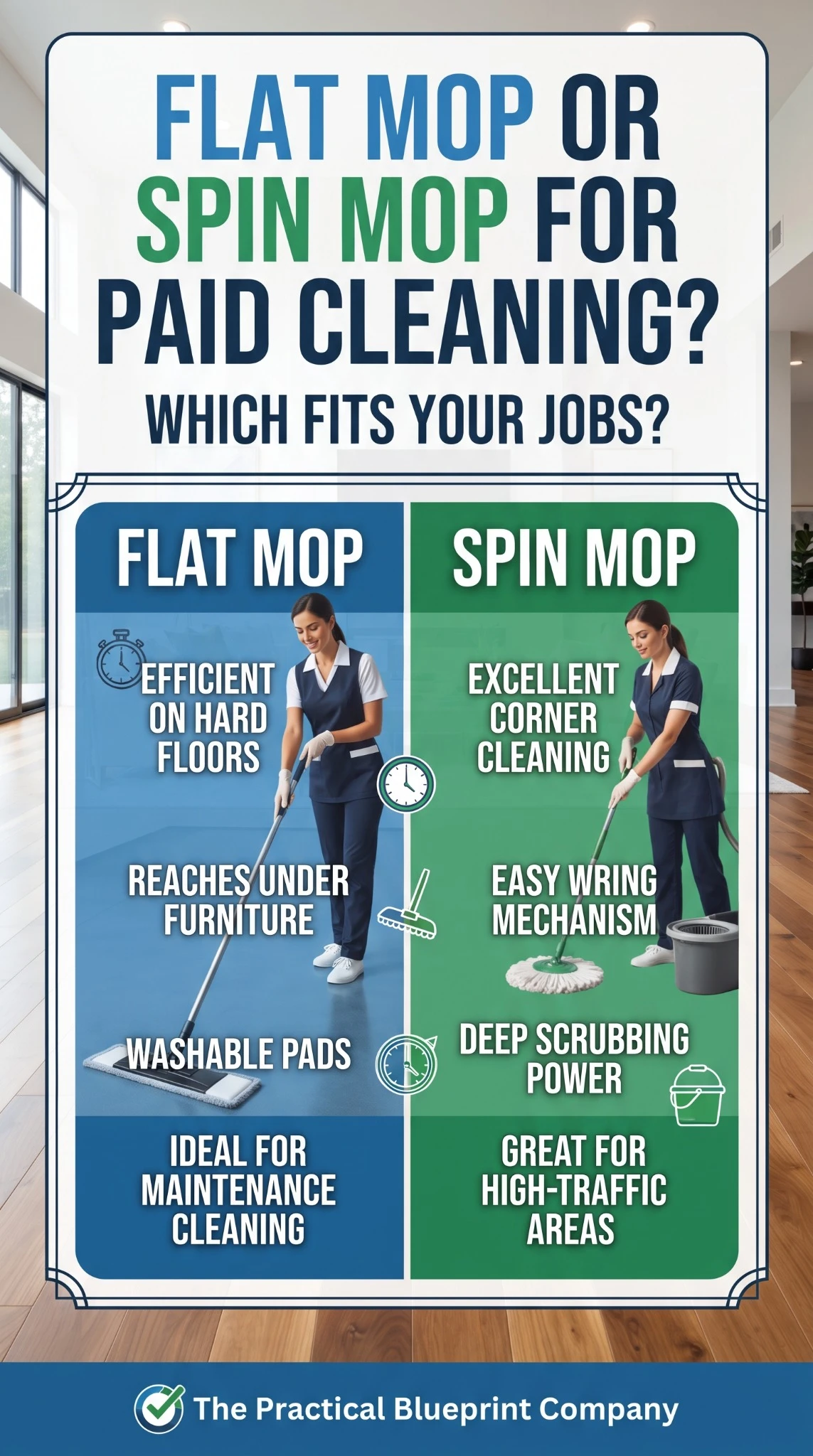
Our Pinterest pin contrasts flat-mop efficiency and washable pads with spin-mop wringing and more demanding areas. Those ideas make a helpful checklist, but the exact head shape, material and cleaning process matter more than the category name.
This guide helps you choose around your customers and running costs. For the wider startup plan, explore our Cleaning Business Startup Bundle.
What is the difference between a flat mop and a spin mop?
A flat mop has a low-profile head holding a pad or cover. Depending on the system, you dampen the pad separately, use a spray bottle or work with a compatible bucket and wringer. Some systems let you replace pads quickly without handling the dirty surface.
A spin mop normally uses a bucket with a spinning basket or mechanism that removes water from the head. Foot-pedal and handle-operated designs are available. Head shapes differ: “spin mop” does not necessarily mean a round head, and a shaped head does not guarantee access to every corner.
Both types may have washable microfibre heads. Both require cleaning, drying and maintenance. A spinning wringer removes moisture; it does not automatically disinfect the head or make used cleaning water clean again.
Start with a survey of your actual jobs
List the floors you are likely to clean. A small kitchen, several bathrooms and a large open-plan living area create different requirements. Identify the floor material and finish, ask about care instructions and note any damage before work begins.
Also consider furniture clearance, stairs, water access, suitable places to empty equipment and space in your car. A compact mop may suit a small flat, while a larger bucket might be manageable in a ground-floor property but awkward elsewhere.
Our guide to questions before quoting for a cleaning job helps you gather these details. Choose equipment after understanding the service, rather than letting a purchase decide what you promise customers.
When a flat mop makes sense
A flat head with a suitable swivel can work well around furniture and across smooth hard floors. Its low profile may help under beds and cupboards where access allows. Check the handle angle and head dimensions: photographs alone will not tell you whether it fits.
For routine maintenance, having several clean pads ready can support a straightforward room-by-room process. You can replace a soiled pad rather than relying on a single head across the whole property. The practical benefit depends on bringing enough pads and keeping clean and used items separate.
A flat system can also be convenient for targeted damp cleaning where the floor manufacturer permits it. However, adding too much solution or using a saturated pad can still leave excess moisture. “Flat” is not a guarantee that a mop is safe for wood, laminate or any particular finish.
Check how covers attach, what replacement pads cost and whether they remain secure during normal use. A cheap handle becomes less attractive if matching refills are difficult to find.
When a spin mop makes sense
A spin system can offer convenient wringing without twisting a mop head by hand. For cleaners who prefer a bucket-based routine, that may make setup and moisture adjustment easier to manage.
Some heads work around fittings and accessible edges effectively, but compare the actual shape and flexibility. The pin mentions corner cleaning; flat heads also reach many corners, and no design reaches behind every toilet or cabinet.
Assess the bucket when filled to its intended working level. Can you lift it comfortably, carry it without spills and empty it using the agreed facilities? If the wringer depends on a pedal or handle mechanism, inspect stability, moving parts and replacement availability.
For dirty areas, water management matters. A two-chamber design may separate some processes, but follow its instructions rather than assuming all spin buckets keep clean and dirty water separate. Change solution when needed and replace or clean heads appropriately.
Compare the job, not just the mop label
| Your requirement | Flat mop considerations | Spin mop considerations |
|---|---|---|
| Under furniture | Low profile may help; check swivel and clearance | Check head and handle clearance |
| Changing cleaning surfaces | Spare pads can be convenient | Check replacement-head process |
| Wringing | Depends on bucket or pad preparation | Integrated spinner may help |
| Stairs and transport | Compact options exist | Assess filled bucket weight and bulk |
| Moisture-sensitive floors | Control pad dampness and application | Check wringing result before use |
| Running costs | Pads, laundry and handle replacement | Heads, laundry and bucket mechanism |
Floor care takes priority over convenience
Check the floor manufacturer’s care instructions and use an approved product at the stated dilution. Karndean, for example, publishes specific cleaning guidance for its flooring; that advice should not be generalised to unrelated materials.
Remove loose grit using a suitable vacuum or sweeping method before damp mopping. Avoid dragging trapped debris across the floor. Work methodically, keep exits usable and manage slip risks while the surface dries.
Do not treat more water, stronger chemical concentration or harder scrubbing as universal ways to improve results. If a mark will not lift with the approved routine, identify the issue and agree an appropriate next step rather than experimenting on a customer’s floor.
The pin’s “deep scrubbing power” message needs this qualification: scrubbing depends on the head, surface and method. A spin bucket itself does not create a powered scrubbing action, and it does not turn a routine mop into a floor-restoration machine.
Keep heads, pads and water organised between jobs
Start each booking with suitable clean equipment. Keep used pads and heads separate from clean stock in containers appropriate for transport, and process them promptly after work. Follow the textile manufacturer’s washing and drying instructions.
A practical separation system might allocate different heads to bathrooms and other areas, with a clearly documented routine. Colours can help you remember the allocation, but colour coding alone does not clean the equipment.
Carry enough spares for the work planned, including a contingency if a head becomes heavily soiled. Clean the bucket and wringer as instructed and dry equipment before storage. Where a contract has specific hygiene requirements, use the required procedures and equipment rather than assuming an ordinary domestic mop meets them.
Calculate the cost of the complete system
Compare purchase price, replacement pads or heads, laundering, expected maintenance and transport. Time spent changing, rinsing, emptying and packing equipment is also working time.
For illustration only, suppose a flat-mop kit costs £35 plus £25 for spare pads, while a spin kit costs £45 plus £15 for a spare head. Both start at £60. Neither figure is a current product price. Their ongoing value depends on durability, replacement availability and how they fit your bookings.
Trial a suitable system on a permitted surface and record total job time, comfort, residue and drying. Avoid claiming a percentage improvement from one informal comparison. Our cleaning-job pricing guide explains why full working time belongs in your business calculation.
Which products should you investigate?
Manufacturer ranges such as Vileda H2PrO include flat and spin systems, making them useful examples to compare. These are research starting points, not hands-on endorsements or confirmation of commercial suitability. Verify the selected model’s instructions, workload support, refills and guarantee for paid use.
For the dry-cleaning stage, our Numatic NRV240-11 review and Henry cordless review discuss equipment already in our Recommended Products section. Neither machine replaces a mop; read our vacuum-buying guide to plan the two stages together.
Our product guides contain disclosed affiliate links where applicable. Browse our Recommended Products for equipment guides, and check exact models and replacement supplies before buying.
A sensible starting decision
If your initial work involves routine maintenance on suitable hard floors, a well-supported flat system with enough spare pads is worth investigating first. If a bucket-based wringing routine suits your properties and handling needs better, investigate a suitable spin system.
Begin with the kit your bookings justify. You can add a second system later if it solves a recurring problem. Our domestic cleaning equipment checklist and starter service guide can help you keep purchases focused.
For services, costs and organisation, explore the Cleaning Business Startup Bundle or view it on Payhip.
Considering a pedal-wringer system? Our Masthome Spin Mop and Bucket Set guide explains five practical benefits and the floor-care and workload checks to make before buying.
Frequently asked questions
Is a flat mop always better for professional cleaning?
No. Consider the exact system, floor, workload and handling. Some jobs suit interchangeable flat pads; others suit a bucket-based routine.
Does spinning make a mop hygienically clean?
No. Wringing removes moisture. Appropriate cleaning, laundering, solution management and separation between tasks are still needed.
Can either mop damage a floor?
Yes, if used with unsuitable moisture, chemicals, abrasive material or trapped grit. Follow the floor and equipment instructions.
Do I need both when starting?
Usually you can begin with one suitable system and adequate spares. Add another when actual jobs show a clear need.
Are household mops automatically suitable for paid work?
No. Confirm intended use, durability, replacement availability and applicable guarantee with the manufacturer before relying on a model for your business.
Sources and further reading
See Vileda’s H2PrO system information for examples of flat and spin designs, and Karndean’s floor-care guidance for a manufacturer-specific cleaning example. Checked 22 October 2026. Always consult the instructions for the exact products and floor involved.
Ready to organise your cleaning business? Put your equipment choices alongside a practical service and startup plan.
Get the Cleaning Business Startup Bundle on Payhip
Explore the blueprint collection for guides, planners and practical worksheets.