
Mobile Coffee Business
How to Price Drinks for a Mobile Coffee Business Without Guessing
Cost your coffee recipes, allow for labour and overheads, understand margin and test realistic sales volumes with clear worked pricing examples.
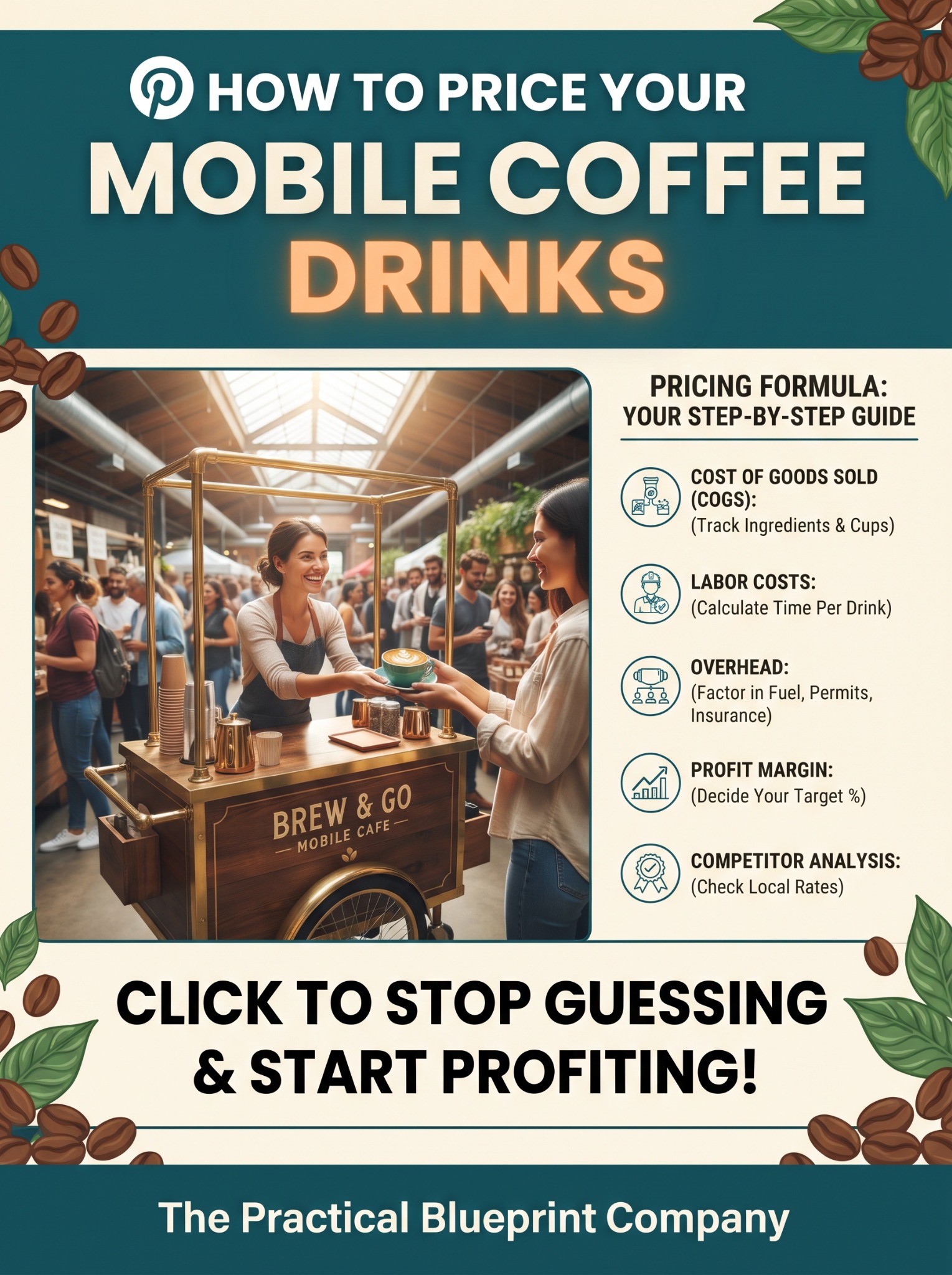
To price drinks for a mobile coffee business, cost each recipe, allow for the full working day and check how many sales your prices need to support. Competitors’ menus provide context, but they cannot tell you what your business needs to earn.
Our Pinterest pin highlights ingredients and cups, labour, overheads, profit margin and competitor analysis. This guide turns those headings into a repeatable method. You will see how to separate money left after making a drink from money left after running the business.
UK-focused planning guide, checked 24 October 2026. All prices, costs, sales volumes and fee rates below are fictional worked assumptions, not supplier quotations, industry averages or earnings forecasts. Replace them with your own figures. Tax treatment depends on your circumstances.
1. Define the drink before costing it
A “latte” is not a sufficiently precise recipe for pricing. Record the cup size, coffee dose, milk quantity, packaging and included extras. A larger cup or an unmeasured syrup pour changes the cost even if the name on the board stays the same.
Start with a short opening menu. Make a recipe card for each drink and size, including the milk quantity you actually use, not simply the cup’s advertised capacity. Record alternative milk, extra shots and syrups separately.
Weigh and measure during practice. Track coffee used for dialling in, milk discarded after steaming and remade drinks. These losses belong somewhere in the budget; ignoring them makes the theoretical recipe cheaper than the real service.
2. Calculate ingredients and packaging per drink
Divide the usable pack quantity into its purchase cost, then multiply by the amount used. Include delivery charges where they form part of obtaining stock. For a business that cannot recover VAT, use the VAT-inclusive cost actually paid.
Ingredient cost per drink = pack cost ÷ pack quantity × quantity used. Keep the units consistent: grams with grams, or millilitres with millilitres.
| Item | Fictional calculation | Cost |
|---|---|---|
| Coffee beans | £18 per 1,000g × 18g dose | £0.324 |
| Milk | £1.20 per 1,000ml × 200ml | £0.240 |
| Cup and lid | Combined cost per set | £0.160 |
| Napkin and other consumables | Allowance per drink | £0.030 |
| Direct recipe subtotal | Ingredients and serving materials | £0.754 |
| Waste and remake allowance | Illustrative additional allowance | £0.076 |
| Recipe cost used below | Rounded planning amount | £0.830 |
The waste allowance is a placeholder to replace with observed results. Do not add it again if you already calculated costs using actual stock consumption, including waste, divided by drinks sold. For a small service, opening and closing losses can be significant even when sales are low.
The pin calls this starting category cost of goods sold, or COGS. Keep your accounting categories consistent, but remember that ingredients and cups are only one part of the pricing decision.
3. Add payment fees and sales-based charges
Check your actual payment provider’s tariff. A percentage fee rises with the selling price; a fixed charge applies per transaction, which may contain several drinks. Allocate it using a realistic basket size rather than automatically charging it to every cup in your calculation.
For this example only, assume one drink per transaction and a payment fee of 1.5% plus 5p. At a selling price of £3.50, the fee is £0.1025. Add that to the £0.83 recipe cost: total variable cost is £0.9325.
Contribution per drink = selling price − variable costs. Here, £3.50 − £0.9325 leaves £2.5675, approximately £2.57, to help pay labour, pitch costs and overheads. It is not yet profit.
If an organiser takes a percentage of sales, include that too. Confirm the commission’s calculation basis and whether other charges apply. Fixed pitch fees belong in the attendance budget; sales-based commissions belong with variable costs in this model.
4. Budget for the full working day
The pin suggests calculating time per drink. That is useful for understanding capacity, but paying yourself only for the seconds spent preparing coffee overlooks much of the job.
Include loading, travel, setup, serving, cleaning and administration. For employees, budget the full employment cost applicable to your situation, not just the headline hourly wage. For an owner-operator, include a deliberate allowance for your time when testing whether the business is worthwhile.
Owner pay in this planning model is an economic allowance. It is not a statement that a sole trader’s drawings are a deductible wage. An accountant can help separate planning decisions from tax reporting.
Suppose one session involves eight total working hours at an illustrative £15 allowance: that is £120. Add £60 for the pitch, £20 for travel and £30 allocated to insurance, maintenance, administration and equipment replacement. The session must then generate £230 of contribution to cover these planned costs.
Allocate monthly or annual overheads across a cautious number of trading sessions. Keep a cash-flow plan as well: buying equipment upfront and allowing for its ongoing use are different views of the business. Our mobile coffee startup budget helps you account for the wider spending commitments.
5. Test the price against realistic sales volume
Using the same £3.50 drink and £2.5675 contribution, divide the £230 session requirement by contribution per drink. The result is 89.58, so you need 90 drinks to cover the modelled costs, including the owner-time allowance.
| Drinks sold | Contribution before session costs | Balance after £230 |
|---|---|---|
| 60 | £154.05 | −£75.95 |
| 90 | £231.08 | £1.08 |
| 120 | £308.10 | £78.10 |
These balances are before income or corporation tax and any costs omitted from the assumptions. This scenario uses a business that is not VAT-registered and assumes every sale is the example drink. The £78.10 is not an earnings promise.
For a mixed menu, use a weighted average contribution based on the expected sales mix, then replace that assumption with actual results. Check busy-period capacity as well as total demand: 90 drinks spread across six hours is different from 90 orders arriving together.
Our guide to finding your first coffee cart pitch explains how to assess footfall and fees before booking. A higher menu price cannot rescue every unsuitable pitch.
6. Understand margin before choosing a target
A markup is measured against cost; a margin is measured against the selling price. If something costs £1 and sells for £4, its markup on that cost is 300%, while the margin against that cost is 75%. Neither figure establishes net business profit if other costs remain unpaid.
For a fully allocated planning cost with no price-dependent fees, the formula is:
Price = cost ÷ (1 − target margin).
Where a percentage payment fee applies, adjust the formula. Suppose our £230 session cost is allocated across 100 expected drinks: £2.30 each. Add the £0.83 recipe and 5p fixed payment fee: £3.18. With a 10% target planning margin and a 1.5% percentage fee:
Price = £3.18 ÷ (1 − 0.10 − 0.015) = approximately £3.59.
A £3.60 menu price would slightly exceed that target under those assumptions. But the result depends on selling 100 drinks, retaining the cost structure and using the stated fee basis. Fewer sales increase the overhead allocation per drink. This is a planning margin after the listed costs, not an accounting guarantee.
Use either the allocated-cost calculation or the session contribution view to organise each calculation. Do not subtract the same labour and overheads twice. The two approaches should reconcile when their assumptions match.

7. Check VAT before finalising the menu
If you are VAT-registered, work with sales excluding output VAT and costs excluding recoverable input VAT where appropriate. The amount the customer pays is not all available to cover your costs. If you are not registered, do not charge VAT separately and generally use the full purchase costs you bear.
HMRC’s catering guidance states that hot takeaway drinks are standard-rated. Check the treatment of your complete menu rather than assuming every food or drink item follows the same rule.
The VAT registration guidance currently sets a £90,000 taxable-turnover threshold, with both a rolling 12-month test and a separate next-30-days test. Special circumstances can change the requirements. Review the official guidance and get advice as your business grows.
8. Compare local prices and simplify your menu
Compare genuinely similar offers: cup sizes, coffee quality, location, convenience and included extras. Record what customers receive, not simply the cheapest number. Another operator may have lower pitch fees, higher volume or a different tax position.
If your required price seems difficult to sell, revisit the menu, waste, supplier costs and pitch. Do not assume the answer is to work unpaid. A smaller menu may improve service speed and reduce stock losses; our equipment checklist helps connect those choices to your setup.
Cost each extra shot, syrup and milk alternative before deciding whether to charge separately or include it. Display sizes, prices and supplements clearly. For private events, quote the complete service commitment: travel, setup, staffing, duration and the agreed drinks allowance.
9. Review results after trading
Keep a simple weekly record of drinks sold by type, revenue, stock used, waste, payment fees, pitch costs and total working hours. Compare actual contribution and session results with the plan.
Review when supplier prices, fees, portion sizes or your sales mix change. Test discounts carefully: taking 30p off a £3.50 drink removes almost 30p of contribution while ingredients and much of the workload remain unchanged. Extra sales must compensate for that reduction.
Frequently asked questions
Can I multiply ingredient cost by three?
You can use it as a rough comparison, but it ignores your workload, pitch costs and sales volume. Build the complete calculation before relying on a multiplier.
Should I be cheaper than nearby coffee sellers?
Only if that price supports your costs and intended service. A competitive price is one customers accept and your operation can sustain; it need not be the lowest.
Should every drink have the same margin?
No. Costs, preparation time and customer expectations vary. Check each item’s contribution and the overall sales mix, especially when promoting a low-contribution drink.
How often should I change prices?
Review regularly, but change them for a clear reason. Use current costs and trading results, update menus consistently and make the price clear before customers order.
Turn your calculations into a working pricing plan
The Mobile Coffee Business Complete Blueprint Bundle includes the 82-page ebook, recipe cards, pricing and break-even workbooks, pitch-profitability tools and operating resources.
Use the editable inputs to test your own recipes, sales assumptions and working costs. Start with one accurately costed drink, then apply the same method across the menu.
Get the Mobile Coffee Business Bundle on Payhip
Explore the blueprint collection for guides, planners and practical worksheets.