
Mobile Car Valeting
How to Keep a Mobile Valeting Business Working Through Winter
Plan winter services, protect equipment, manage weather cancellations and price shorter working days with a practical weekly action plan.
Keeping a mobile valeting business working through winter means adapting your services, protecting your equipment and leaving room for weather changes. You cannot control a frozen driveway or a week of heavy rain. You can control the promises you make, the work you accept and how quickly you offer customers a sensible alternative.
Winter brings mud, wet mats and dirty glass, so customers still have reasons to book. The difficulty is delivering a useful result safely and profitably within shorter working days. A full diary is not much help if every appointment depends on perfect outdoor conditions.
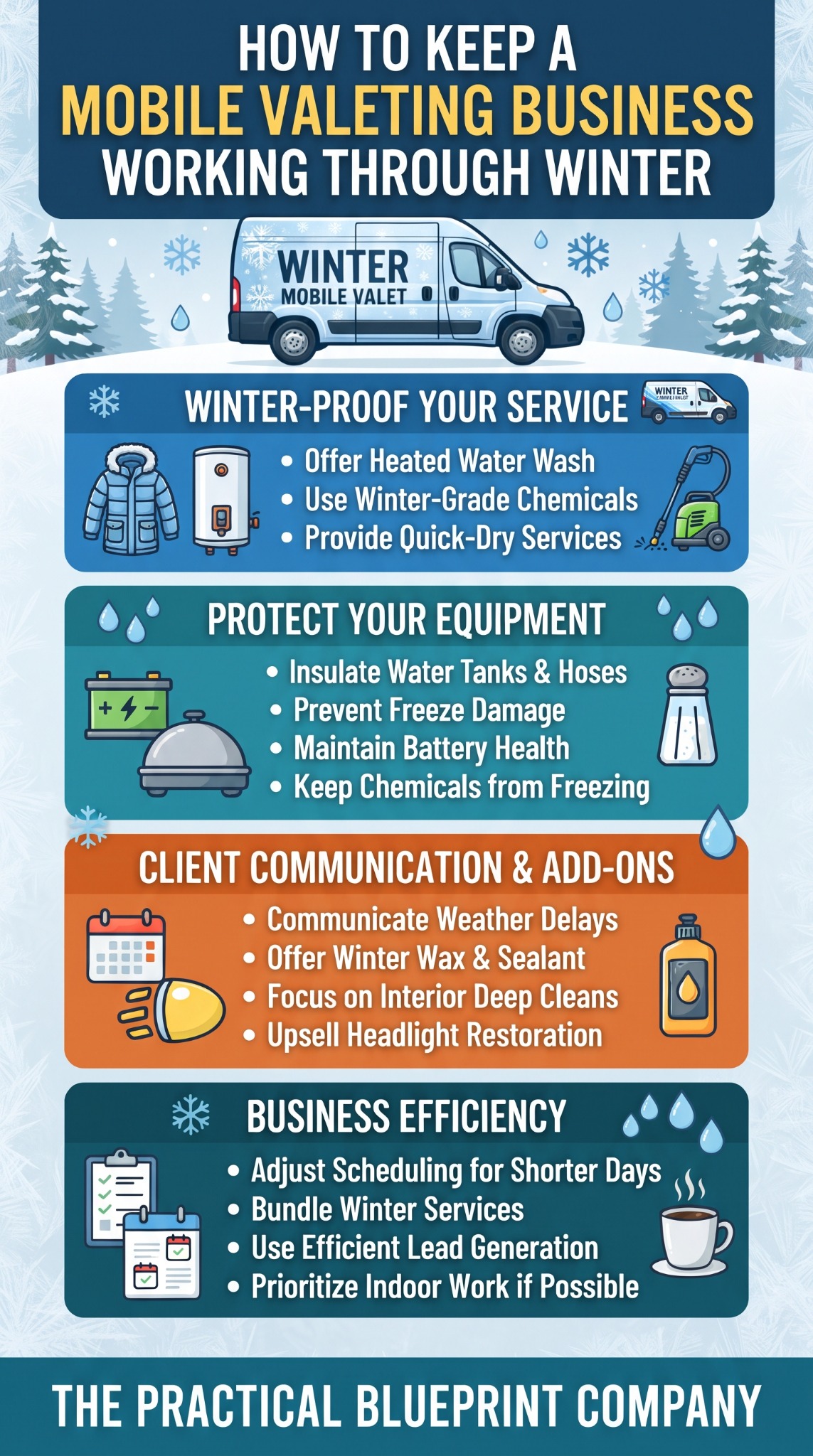
Our Pinterest pin groups the challenge into four areas: services, equipment, customer communication and efficiency. This guide turns those ideas into a practical plan for a small UK mobile valeting business. Start with what your current setup can reliably deliver before buying upgrades.
1. Build a winter menu you can actually deliver
Keep the offer clear. Three well-defined choices are easier to schedule and explain than a long list of extras you may have to withdraw on arrival.
- Interior maintenance: vacuuming, suitable surface cleaning, interior glass and a tidy finish, with clear exclusions for heavy staining, mould or excessive contamination.
- Exterior maintenance: a suitable wash, wheels and finishing steps when temperature, drainage and weather allow.
- Winter protection appointment: appropriate preparation and a compatible protective product, applied only within its stated conditions.
Describe tasks rather than vague promises such as “winter-proof your car”. A protective product does not prevent every form of damage or remove the need for maintenance. Explain what is included, likely duration and whether the vehicle needs shelter afterwards.
Offer interior-only work as a genuine choice rather than a surprise substitute for a booked exterior service. Doors may need to stay open, access must be safe and the working area still needs suitable conditions. Heavy rain can make even an interior appointment impractical.
If you are still building your service list, read our mobile car valeting equipment checklist and explore the Mobile Car Valeting Business Blueprint to organise your starting decisions.
2. Set clear weather decisions before the booking
A forecast air temperature is only one part of the decision. Shaded paving and vehicle surfaces may remain colder than expected. Consider ground conditions, likely runoff, wind, visibility and your equipment and chemical operating limits.
Do not wash where water could freeze on access routes or leave a hazard for the customer after you depart. HSE guidance highlights the need to assess outdoor ice risks and monitor forecasts and temperatures. A warning cone alone does not make an unsafe washing location acceptable.
Use three simple outcomes: proceed as booked; agree a suitable alternative service; or postpone. Decide again on arrival because a forecast cannot show every driveway. Stop if conditions deteriorate.
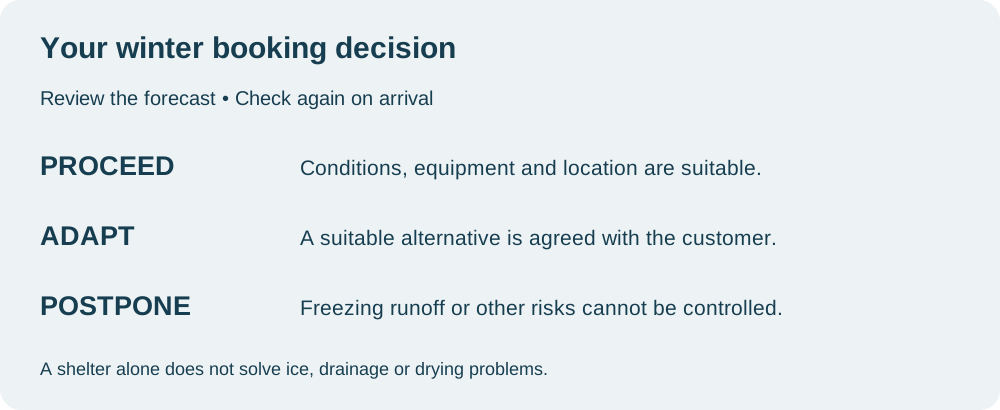
A gazebo is not a complete winter solution. Follow its wind limits, anchoring instructions and site permissions. It does not warm frozen ground or solve drainage. Never use an improvised enclosure to run combustion equipment; exhaust gases can be deadly.
3. Protect pumps, hoses and chemicals every evening
Freeze damage can turn a lost morning into a much larger repair bill. Kärcher explains that residual water freezing inside a pressure washer can damage seals and the pump. Your own machine’s manual should determine its draining and storage procedure.
Create a shutdown checklist covering the washer, hoses, connectors, reels, tanks and any water-fed accessories. Relieve pressure, drain as instructed and store vulnerable equipment in a suitable frost-free space. Do not assume a closed van or unheated shed stays above freezing.
Insulation slows temperature change; it does not produce heat. Insulating tanks and hoses can help as part of a wider plan but cannot guarantee protection during a long freeze. Any installed heating needs to be suitable, professionally assessed where appropriate and compatible with the vehicle, electrical supply and insurer’s requirements.
Keep chemicals in their original labelled containers and follow storage limits and safety data sheets. Do not assume a frozen product becomes usable again after thawing. Ask the supplier if it has been stored outside its permitted range.
Follow battery and charger temperature instructions too. Cold-weather discharge and charging limits can differ. Keep connections dry, inspect cables and do not improvise heaters around batteries or chemical stock.
4. Treat heated water and “winter-grade” products carefully
The pin suggests heated-water washing. That may be useful with a compatible system, but it is not essential for every beginner and does not prevent runoff from freezing. Confirm the washer’s inlet-temperature limit, plumbing compatibility and safe operating procedure before considering an upgrade.
Do not pour hot water onto frozen glass or use it as a shortcut to making icy surfaces workable. If the vehicle or site is frozen, rescheduling may be the sensible decision.
Similarly, “winter-grade” is not enough information to choose a chemical. Check its actual application temperature, dilution, surface compatibility, dwell time and rinsing requirements. A stronger mix is not automatically a better cold-weather solution. Never mix products unless their manufacturer explicitly instructs you to do so.
Our Autoglym car-care collection guide explains one existing product option and its limits. It is not a claim that every item suits freezing conditions or commercial use. Check labels, supplier advice and cost per job. That product page contains an affiliate link; we may earn a commission from qualifying purchases.
5. Plan interior cleaning around drying time
Interior work can help diversify your diary, but promising a “quick-dry deep clean” without controlling moisture is risky. Cold, damp conditions may extend drying. A customer who needs the car immediately may be better suited to a low-moisture maintenance service.
Before accepting upholstery extraction, ask about the materials, contamination, shelter, ventilation, power and when the vehicle must next be used. Assess whether you can dry it adequately and explain any aftercare honestly. Do not leave seats soaked and present an uncertain drying time as a guarantee.
Avoid dressing pedals or leaving steering controls slippery. Use appropriate products on touchscreens and sensitive surfaces, and confirm compatibility before starting. Mould, flood damage and bodily-fluid contamination may require specialist assessment rather than an ordinary winter package.
Good cloth management matters in wet weather. Carry enough clean, dry cloths, separate dirty items and allow time for laundry between working days. Our microfibre cloth care guide covers organising and cleaning your stock.
6. Build shorter days into your prices
Winter jobs can involve more travel time, setup, drying and rescheduling. Measure the complete appointment rather than pricing only the minutes spent cleaning. A smaller service radius and fewer, well-planned bookings may produce a better working day.
For an illustrative interior appointment, allow 90 minutes for the service, 30 minutes for setup and packing and 30 minutes for travel and administration: 2.5 hours total. At a target labour allowance of £20 per hour, that is £50 before consumables, vehicle costs, insurance, laundry, payment charges, tax planning and profit. It is a costing example, not a recommended market price.
If your existing price cannot support the total time, adjust the scope, route or price. Adding an extra service free of charge is unlikely to solve the problem. Our guide to pricing mobile valeting without undervaluing your time takes the calculation further.
Keep a weather buffer in the weekly diary. Two realistic appointments plus recovery time can be more dependable than three tightly packed jobs that all run late. Use the best daylight for work that needs good visibility, leaving preparation and administration for darker hours.
7. Make postponements easy for customers
Explain your weather policy before taking the booking, including when you will review conditions, how you will contact the customer and what happens to deposits. Use fair, clear terms and distinguish a customer cancellation from your own decision that the job cannot proceed safely.
A straightforward message might say: “I’m reviewing tomorrow’s conditions because frost is forecast. I’ll confirm by 6pm today. If the location is unsuitable, we can agree an appropriate interior service or move the appointment. I’ll check conditions again when I arrive.”
Follow that promise with an actual update. Offer specific replacement dates instead of leaving someone waiting indefinitely. Ask permission before changing the service, price or location, and confirm the revised arrangement in writing.
Ask whether regular customers want a reminder for their next maintenance visit. Keep contact relevant and respect their preferences. A consistent relationship is more useful than repeatedly advertising emergency discounts.
8. Find repeat work and suitable sheltered locations
Start with existing customers who already know your work. Explain the winter menu and ask about covered parking, access and their preferred maintenance interval. A home garage is only useful if there is enough space, suitable ventilation and safe access.
Approach local businesses with an appropriate work area and consider whether several vehicles at one location would reduce travel. Agree permissions, responsibilities, insurance, power, water and wastewater arrangements before accepting a block booking. Shelter does not automatically make a location suitable for commercial washing.
In England, GOV.UK pollution guidance identifies vehicle washwater as potentially contaminated trade effluent. Keep it out of surface-water drains and arrange authorised collection or permitted disposal. Check requirements with the relevant regulator and sewerage provider for your location; rules and permissions differ across UK nations.
Headlight restoration, mentioned on the pin, is a specialist service to assess separately. It needs suitable training, insurance, preparation and compatible finishing protection. Do not add it merely because exterior washing has slowed.
Your first-week winter action plan
- Review your last few jobs and record complete time and costs.
- Write three clear winter service descriptions with exclusions.
- Check manuals, chemical storage limits and frost-free storage arrangements.
- Prepare your weather message and fair rescheduling terms.
- Contact existing customers about suitable maintenance bookings.
- Cluster appointments geographically and reserve a weather recovery slot.
- Review what worked before buying extra equipment.
Use cancelled outdoor time for laundry, equipment checks, bookkeeping and improving your service pages. Build a cash buffer gradually from workable weeks, based on your actual fixed costs. Winter resilience comes from a repeatable routine and realistic commitments.
For help organising your wider startup, view the Mobile Car Valeting Business Blueprint on Payhip. You can also explore our guide to starting without a van and save ideas from our Practical Blueprints Pinterest board.
Frequently asked questions
Can a mobile valeting business work throughout winter?
Yes, but not every service will be possible every day. Adapt your menu, plan suitable locations and keep space for postponements. Do not promise uninterrupted outdoor washing.
At what temperature should I stop washing?
There is no single threshold that covers every site, surface, product and machine. Follow operating limits and assess freezing runoff, ground conditions and the forecast. Postpone if you cannot control the risks.
Do I need a hot-water pressure washer?
Not automatically. First improve scheduling, storage and service scope. An upgrade needs a clear business case and does not make an icy location safe.
Are interior deep cleans the best winter service?
They can suit appropriate sheltered conditions, but drying is critical. A low-moisture maintenance clean may be a better match when time, ventilation or weather makes extraction unsuitable.
Should I discount to keep busy?
Calculate costs first. A tightly defined maintenance package or grouped bookings can be more sustainable than a broad discount on labour-intensive work.
Sources and practical limits
Checked 25 October 2026: HSE guidance on ice and outdoor slip risks; Kärcher frost-protection guidance; GOV.UK pollution prevention for businesses. Follow your exact equipment manuals and product instructions. This is general business planning guidance; the pricing example is illustrative.
Get the Mobile Car Valeting Business Blueprint on Payhip
Explore the blueprint collection for guides, planners and practical worksheets.