Cleaning Business Startup
How to Choose a Name for Your Cleaning Business
Create and test a cleaning business name with practical examples, UK naming and trade mark checks, domain tips and a simple shortlist process.

Choosing a name can make your cleaning business feel real. Suddenly you can imagine the leaflet, the work shirt and the first enquiry. It can also become a surprisingly effective way to postpone the harder decisions about services, prices and customers.
You do not need the cleverest name in town. You need one that is easy to understand, easy to recommend and suitable for the work you want to do. It also needs checking before you spend money putting it on everything.
This guide gives you a practical process: define your offer, create a shortlist, test it with people and complete the relevant UK checks. The example names are starting points for discussion, not names confirmed as available.
Our Cleaning Business Startup Bundle helps you work through your customers, services, pricing and first bookings. Get the complete bundle on Payhip and build a business behind the name.
1. Decide what the name needs to communicate
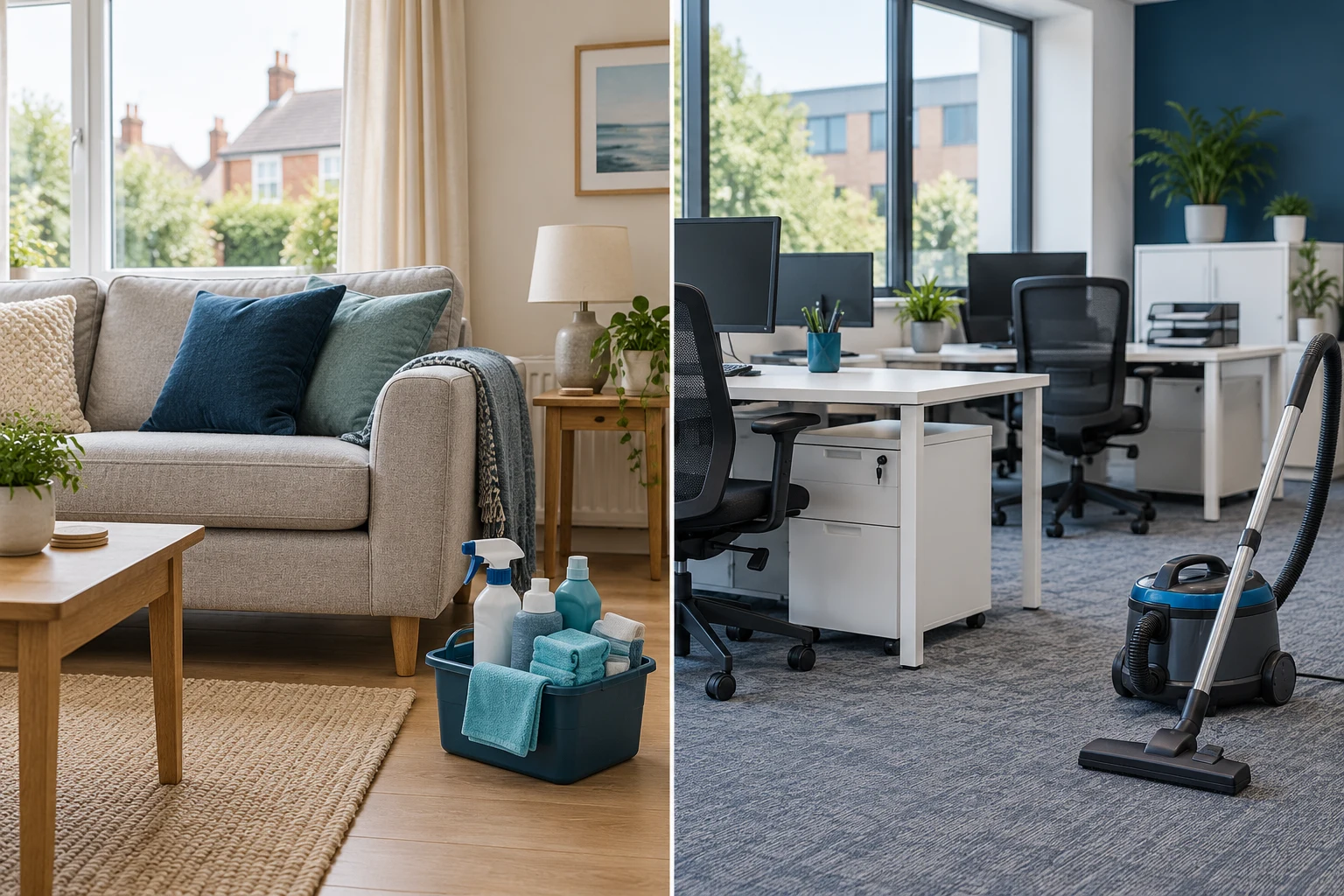
Before brainstorming, finish this sentence: “We provide [service] for [customer] in [area].” For example, you might offer regular home cleaning for busy households in three neighbouring villages, or evening cleaning for small local offices.
That sentence helps you judge whether a name fits. A playful household name might suit friendly domestic marketing but feel less appropriate on a formal office proposal. A name focused on ovens could become restrictive if your main service is actually regular house cleaning.
If you have not chosen your starting market, read Domestic or Commercial Cleaning: Which Business Should You Start? first. Your name should support a clear offer rather than conceal an undecided one.
Choose two or three qualities you want to convey, such as care, consistency and straightforward communication. Avoid trying to squeeze every service and promise into the name itself.
2. Choose a naming approach that suits your plans
There is no single best formula. Compare the following approaches and decide which trade-offs you can live with. All examples are illustrative and require independent checks before use.
| Approach | Illustrative example | What to consider |
|---|---|---|
| Your own name | Alex Morgan Cleaning | Personal and direct, but may suggest that Alex attends every visit. |
| Local identity | [Town] Home Cleaning | Shows the area clearly, but may feel restrictive if you expand. |
| Distinctive word plus service | Hearthlane Cleaning | Offers a recognisable brand, provided people can spell and remember it. |
| Customer or setting | Neat Desk Cleaning | Suggests office work, but may not suit a later domestic offer. |
| Service-led name | [Surname] Oven Cleaning | Explains a specialism immediately, but commits you to a narrower message. |
Using your own name can work well for an owner-operated service. Think about whether customers will still understand the brand if you later recruit someone. A separate business name may give you more flexibility, but it still needs a clear explanation of the service.
A local name can be useful when you intend to stay local. You can also keep the main name broader and put the area in a supporting line: “Regular home cleaning in [town] and nearby villages.”
3. Build a shortlist without getting stuck
Give yourself one focused brainstorming session. Make three small lists: words connected with your service, words describing the experience you want customers to have, and personal or local references you would be comfortable using.
Combine a few options, then say each aloud. Aim for perhaps ten initial ideas and reduce them to three serious candidates. Remove names that need a long explanation, sound like another cleaner or rely on awkward spelling.
A name generator can help you explore combinations, but its suggestions are not evidence of originality or legal availability. Treat every result as an unchecked draft.
Keep rejected ideas in your notes. You may need a second choice after checking the first, and a useful descriptive phrase could become a strapline instead.
4. Use the telephone and recommendation tests
Imagine answering an enquiry: “Good morning, [business name], Alex speaking.” Does it sound natural? Now imagine a customer telling a neighbour which cleaner they use. Can the neighbour remember and search for it?
Ask someone to write the name after hearing it once. If they repeatedly misspell it, add an unexpected letter or confuse one word with another, that is useful feedback. A quirky spelling can create extra work every time you give out your email address.
Check the initials and the words joined together without spaces. A name that looks elegant on paper may become confusing as a web address or social handle.
Then put it in plain black text on a sample quote. If it only works with a complicated logo, decorative lettering or a joke explained underneath, reconsider it.
5. Check existing businesses before buying anything
Search the full name online, then try its main words, similar spellings and names that sound alike. Check maps, local directories and relevant social platforms, including neighbouring areas where you might trade.
Look beyond exact matches. A nearby cleaner with a very similar name can create confusion even when your spelling differs. Consider whether customers could contact the wrong business, attribute a review incorrectly or mistake your leaflet for theirs.
Search the Companies House name availability checker if you plan to incorporate, and review existing companies as part of your wider research. The register does not represent every sole trader or every name already used in trade.
Record what you checked and when. If a close match creates uncertainty, get suitable advice or choose a more distinctive option before ordering signs or printing.
6. Understand the UK naming and trade mark checks
Your trading name, registered company name, domain and trade mark are different things. One successful check does not replace the others.
According to GOV.UK's sole trader naming guidance, you can trade under your own name or another business name. Sole trader names must not be offensive or use terms such as “Limited”, “Ltd” or “LLP”. The guidance also requires your own name and business name, if you use one, on official paperwork such as invoices and letters.
If you form a limited company, follow the separate company naming rules. These cover names that are the same as or too similar to existing names, and restrictions involving sensitive words or implied official connections. Adding punctuation is not a reliable way around a name conflict.
Use the UK trade mark search service to investigate identical and similar marks. Consider the services they cover, not just whether the spelling matches. If the results are unclear, a trade mark professional can help you assess them.
Companies House explains that registering a company name does not automatically protect it under trade mark law. Equally, buying an available domain does not settle whether you can lawfully use the brand. Treat these checks as part of your preparation, not a guarantee supplied by a naming tool.
7. Check the domain and social handles
Once a candidate survives your initial checks, look for a sensible web address and handles on the platforms you intend to use. Short, readable versions are easier to share than strings containing several hyphens or unexplained numbers.
If the exact domain is taken, investigate who uses it before simply adding “UK” or “services”. The existing site may reveal a business you missed. An alternative domain should still be easy to explain and should not create confusion with another operator.
Check renewal costs as well as introductory prices. Keep account access and renewal details organised, and use business-controlled accounts rather than leaving the domain in a designer's personal account.
Do not stretch an unsuitable name merely because its domain is cheap. The address should support the business you have chosen.
8. Test the strongest names with potential customers
Show your three candidates to a small number of people who resemble your intended customers. Ask what service they expect, which name they remember after a few minutes and whether any wording feels confusing.
“Which one do you like?” is less useful than “What would you expect this business to do?” Friends may enjoy a pun that leaves a householder or office manager unsure about your service.
Score each candidate from one to five for clarity, pronunciation, spelling, customer fit and room to grow. Use the scores to organise your thinking, not to overrule a serious conflict discovered during your checks.
For example, a solo cleaner planning a small team might prefer a broader brand over a name that promises the owner's personal attendance. Someone deliberately building a small personal service may reasonably choose the opposite.
9. Make the name consistent, then move on
After completing the checks and choosing your name, write down its exact spelling, capitalisation and supporting description. Use that version consistently across your website, quotes, invoices and social profiles, while including the legal business details required for your structure.
Avoid unsupported claims in the name or strapline. Words implying certification, official approval or environmental benefits should reflect something you can substantiate. A straightforward description is often more useful than a sweeping promise.
Then return to the decisions that generate a workable business: your service area, task list, pricing and enquiry process. Our guides to pricing a cleaning job and finding your first cleaning clients are useful next steps.

Turn the name into a launch plan
The Cleaning Business Startup Bundle brings together planning guidance, practical workbooks and an editable business tracker. Use it to connect your name with a clear offer and organised customer experience.
Frequently asked questions
Should “cleaning” be in my business name?
It can make the service immediately clear. If you choose a less descriptive brand, use a simple supporting line explaining what you clean and where you work.
Can I use my own name?
Yes, a sole trader can trade under their own name. Consider privacy, customer expectations and how the name will work if you later hire others.
Does an available domain mean the name is safe to use?
No. Domain availability is separate from company naming and trade mark considerations. Check existing businesses and relevant registers before committing.
Should I choose a funny cleaning business name?
Only if the humour suits your audience and remains clear when spoken or written. Test it with potential customers and avoid wording that could embarrass them when recommending you.
Can I change the name later?
Rebranding is possible, but involves updating customer communications, accounts, marketing and any relevant registrations. A careful initial choice can save that disruption.
Start your cleaning business with a clear plan
Move from name ideas to services, pricing and your first bookings with practical guidance and supporting tools.
Get the Cleaning Business Bundle on PayhipExplore the blueprint collection for guides, planners and practical worksheets.