Pressure Washing
Surface Cleaner Attachment or Standard Lance: Is the Upgrade Worth It?
Compare surface cleaners and standard lances, check machine compatibility and calculate realistic payback, with a free buying checklist.
A surface cleaner attachment can be a worthwhile upgrade when you regularly clean suitable, reasonably flat patios and driveways. It can help you cover open areas more consistently and contain some of the splash. But it needs to match your pressure washer, your surfaces and the jobs you actually book.
For a new pressure-washing business, the best question is not “Which tool looks more professional?” It is “Will this attachment improve the finished result or save useful time often enough to justify its cost?” In many cases, the sensible setup includes both a surface cleaner and a standard lance.
What is the difference?
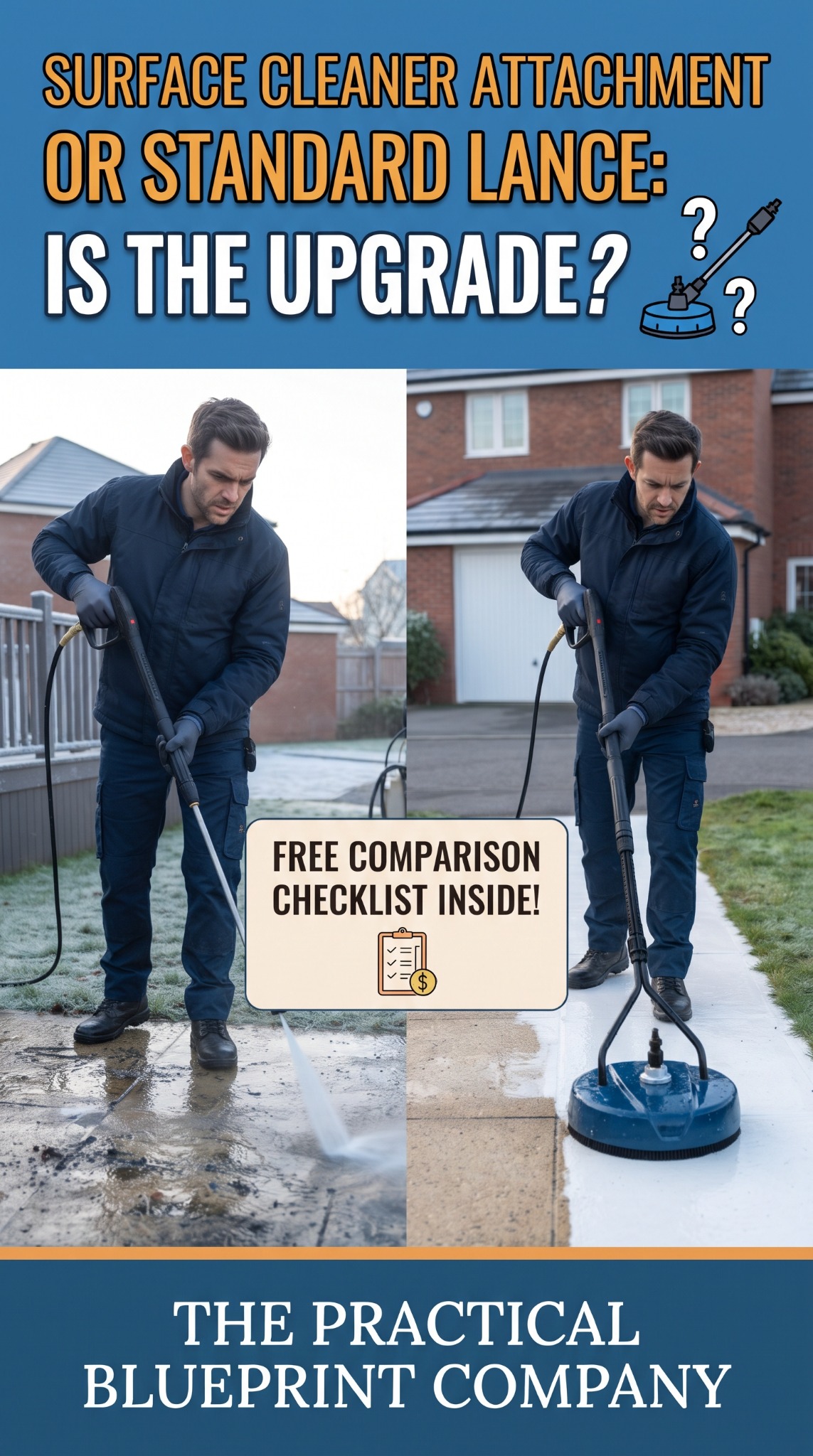
A standard lance directs water through a nozzle that you move across the surface. You control the position, angle, distance and pace. That makes it useful for targeted work, but covering a large area evenly requires care and practice.
A typical rotary surface cleaner has a housing over a rotating spray bar. Jets sweep across a wider working area underneath it. The housing helps contain spray, while the design maintains a more consistent relationship between the nozzles and the surface.
Different models behave differently. Some compact attachments are intended for occasional household use; others are built for professional work and need machine-specific nozzles. A wider housing does not create extra power, and an attachment cannot turn an unsuitable pressure washer into a suitable one.
Choosing equipment for a new business? Our Pressure Washing Business Starter Bundle connects equipment decisions with pricing, site checks and everyday job planning.
Surface cleaner or lance: a practical comparison
| What matters | Surface cleaner attachment | Standard lance |
|---|---|---|
| Open, fairly level areas | Often a good fit when correctly matched to the machine and surface. | Can complete the work, but maintaining even coverage takes care. |
| Edges, corners and awkward spaces | The housing may limit access. | Useful for targeted access with a suitable nozzle and method. |
| Splash | A housing can reduce outward spray; it does not eliminate runoff. | More exposed spray needs careful direction and control. |
| Finish | Can improve consistency, but incorrect setup or technique can leave marks. | Depends strongly on nozzle choice, distance, overlap and pace. |
| Initial spending | Adds cost, possibly including nozzles, fittings and maintenance parts. | Usually already included with the pressure washer. |
| Ongoing work | Jets, rotating components, skirt and wheels may need attention. | Nozzle, lance, gun and connections still require inspection. |
Neither option guarantees a damage-free clean. The surface condition and the settings remain more important than the shape of the accessory.
When the upgrade is most likely to earn its place
Look at your recent enquiries. Are customers asking for substantial areas of suitable paving or concrete, with enough clear space to move the attachment? If so, a compatible surface cleaner deserves consideration.
The advantage is easier to realise when you can use it for a meaningful portion of the appointment. A large, accessible area may suit it well. A tiny courtyard crowded with pots, narrow passages and steps may leave you switching tools frequently.
It can also help you build a repeatable routine: prepare the area, clean suitable open sections, address edges and rinse or recover the dirty water as planned. Consistency matters when you are quoting jobs and trying to understand how many appointments fit into a working day.
Before buying, consider a supplier demonstration or an appropriate hire option. Check that the demonstration uses equipment comparable to yours. A result achieved with a different machine and water supply may tell you little about your own setup.
When keeping the lance makes more sense
If your first bookings are small, irregular or mostly detailed work, a surface cleaner may not be the next purchase you need. Better hose management, suitable nozzles, equipment maintenance or more practice could address the actual bottleneck.
A lance remains useful for controlled edge work, accessible steps and rinsing where the surface and surroundings permit it. Choose the method for each area rather than trying to force one attachment into every space.
Do not confuse a standard fan nozzle with a turbo or rotary nozzle. These produce different spray patterns and can behave very differently on a surface. A more concentrated cleaning action is not automatically the right answer to a stubborn patch.
There is also no need to retire a functioning lance when you buy a surface cleaner. The two tools normally complement each other.
Check compatibility before checking the price
Start with the exact model numbers of your pressure washer and proposed attachment. Send them to the manufacturer or a knowledgeable supplier if the documentation is unclear.
- Water flow: Compare the machine’s rated flow with the attachment’s requirements. Keep units consistent; litres per hour and litres per minute are not interchangeable figures.
- Pressure: Check working requirements and maximum ratings throughout the setup, including connectors and hoses.
- Nozzles: Confirm the correct nozzle set for the machine, including whether it is supplied.
- Connection: Check thread or connector type and any manufacturer-approved adapter requirements.
- Temperature: Confirm water-temperature limits if using a hot-water machine.
- Intended use: Check whether the accessory is suitable for paid work and your expected workload.
For example, Kärcher’s professional FR 30 information says its machine-specific nozzle kit is ordered separately. That is a useful reminder that the advertised attachment price may not cover a ready-to-use setup.
Also check the manual rather than assuming every product from a familiar brand is intended for commercial use. The Kärcher T 5 instructions, for instance, specify private-household use. These are examples of checks to make, not recommendations to buy either model.
Will a bigger surface cleaner finish faster?
Not necessarily. Width is only useful when the machine can support the attachment’s intended performance. An oversized or poorly matched cleaner may need slower movement or repeated passes, reducing the benefit you expected.
Choose from the manufacturer’s approved combinations and nozzle guidance. Avoid relying on a universal internet rule that links a particular diameter to one headline pressure figure. Flow, nozzle selection and the complete setup matter too.
Practical handling also counts. Can the head fit through gates, move around obstacles and travel securely in your vehicle? Can you guide it comfortably for the kind of appointments you plan to accept? A tool that is awkward to transport or use may save less time than its working width suggests.
Check the surface before either tool touches it
Identify the material and inspect its condition. Loose joints, damaged coatings, crumbling areas and uncertain finishes need assessment before pressure cleaning. A covered spray head does not make high pressure suitable for every surface.
Follow the surface manufacturer’s care guidance where available, select an appropriate method and test an inconspicuous area. Some jobs require a different cleaning approach or specialist advice. Agree any limits with the customer before starting.
For block paving, discuss jointing material and any follow-up work the chosen cleaning method may require. Do not quote only for the washing stage if the customer expects a complete finished service.
Keep people and pets away, use suitable protection and follow the tool’s operating instructions. Never reach under an operating cleaner; shut down and release pressure according to the equipment instructions before inspection or adjustments. The T 5 manual also stresses keeping its head on the cleaning surface before triggering and keeping it moving during use.
Neither a splash skirt nor a neat-looking finish solves wastewater management. Plan collection or appropriate disposal for the site and contaminants. Ordinary surface cleaners do not automatically recover dirty water; recovery-equipped models are a separate specification to check.
Calculate whether the time saving is worth the cost
Use the complete purchase cost: attachment, correct nozzles, required fittings and delivery. Then estimate the time saved across the whole appointment, allowing for tool changes, edges, rinsing and cleaning the accessory afterwards.
A simple illustrative payback calculation
Suppose a compatible setup costs £300, saves 30 minutes on each suitable job and you value that working time at £25 per hour.
0.5 hours × £25 = £12.50 of time value per job.
£300 ÷ £12.50 = 24 suitable jobs to match the purchase cost, before maintenance and other additional costs.
If the saving is only 15 minutes, the calculation becomes 48 suitable jobs. If most of your bookings are unsuitable for the attachment, reaching either total takes longer.
These are planning assumptions, not product prices or promised performance. Time saved is not automatically extra income. It produces a cash benefit only when it reduces paid costs or helps you complete additional profitable work. Finishing earlier may still be valuable, but distinguish that personal benefit from money received.
If you charge a fixed job price, better efficiency may improve your return per working hour. If you charge by the hour, consider how your pricing and customer expectations work before assuming faster cleaning increases revenue.
Make the equipment fit the business plan. The Pressure Washing Business Starter Bundle includes an ebook and ten companion PDFs covering areas such as planning, pricing, bookings and site inspections.
Your free comparison checklist
Copy this checklist into your equipment notes before ordering:
- My typical jobs contain enough suitable open surface to use the attachment regularly.
- I have confirmed compatibility using exact machine and attachment model numbers.
- Flow, pressure, nozzle selection, connection and temperature limits match.
- The intended use and warranty terms fit my planned business work.
- I know which nozzles, adapters and other parts cost extra.
- The cleaner fits my transport, storage and usual site access.
- I can obtain replacement parts and understand routine maintenance.
- I have allowed for edges, rinsing, runoff management and finishing work.
- My payback estimate uses realistic whole-job time savings.
- I can buy it without sacrificing essential equipment, maintenance or working cash.
If several answers are uncertain, pause the purchase and resolve them. Asking a supplier a few precise questions is easier than returning a tool that technically connects but does not suit your work.
Frequently asked questions
Will a surface cleaner eliminate stripes?
No. Matching the equipment and using suitable technique can improve consistency, but nozzle problems, movement and surface variation can still affect the result. Stop and investigate poor results rather than repeatedly passing over the same area without understanding the cause.
Can I use any surface cleaner with any pressure washer?
No. A connection that fits is only one part of compatibility. Check the complete specification and approved nozzle arrangement.
Does a surface cleaner use less water?
Do not assume it does. Total water use depends on flow and how long water runs, including rinsing and repeat passes. Measure comparable complete jobs before claiming a saving.
Should I buy one before my first booking?
Only if your planned work and confirmed equipment requirements justify it. Starting with a suitable existing setup and upgrading after you understand demand can be a sensible choice.
Buy for the work you expect to do
A compatible surface cleaner can be a useful upgrade for repeat flat-surface work. Keep the lance for jobs it handles well, measure the real benefit and choose a setup you can maintain.
For the wider picture, read our guides to scheduling pressure-washing jobs and knowing when to postpone in cold weather.
Plan your pressure-washing business with confidence
Bring your equipment choices, pricing and customer arrangements together with the Pressure Washing Business Starter Bundle.
Explore the blueprint collection for guides, planners and practical worksheets.