
Mobile Car Valeting
How to Price Mobile Car Valeting Services Without Undervaluing Your Time
Calculate a sustainable mobile valeting price with travel, setup, overheads and your time included, plus a worked example, clear packages and practical quoting advice.

To price mobile car valeting properly, cover your total working time, the costs of each booking and a realistic share of your business overheads. Then check that the service makes sense to customers in your area. Copying the cheapest local wash rarely tells you whether your own business can survive.
You might spend ninety minutes cleaning a car, but the booking can also involve messages, loading, driving, setting up, packing away and washing cloths. Those minutes belong in your calculation. A busy diary is only useful if the work leaves enough money to support you.
This beginner-friendly guide explains a practical pricing method, with an example you can adapt. All figures are illustrative planning assumptions, not surveyed UK prices or promised earnings. For the wider launch plan, start with our Mobile Car Valeting Business Blueprint.
Published October 2026. Product guides linked below contain affiliate links. We may earn a commission from qualifying purchases, at no extra cost to you.
1. Define exactly what the customer is buying
Before deciding a price, write a checklist for the service. “Full valet” means different things to different people. One customer may expect a vacuum and wipe-down; another may expect seat shampooing, stain removal and polished paintwork.
A clearer starting offer is an interior maintenance clean: vacuum accessible seats, carpets, mats and boot; clean suitable hard surfaces; and clean interior glass. State whether moving child seats, removing belongings or extracting upholstery is excluded. Avoid promising stain removal or odour elimination you cannot reliably deliver.
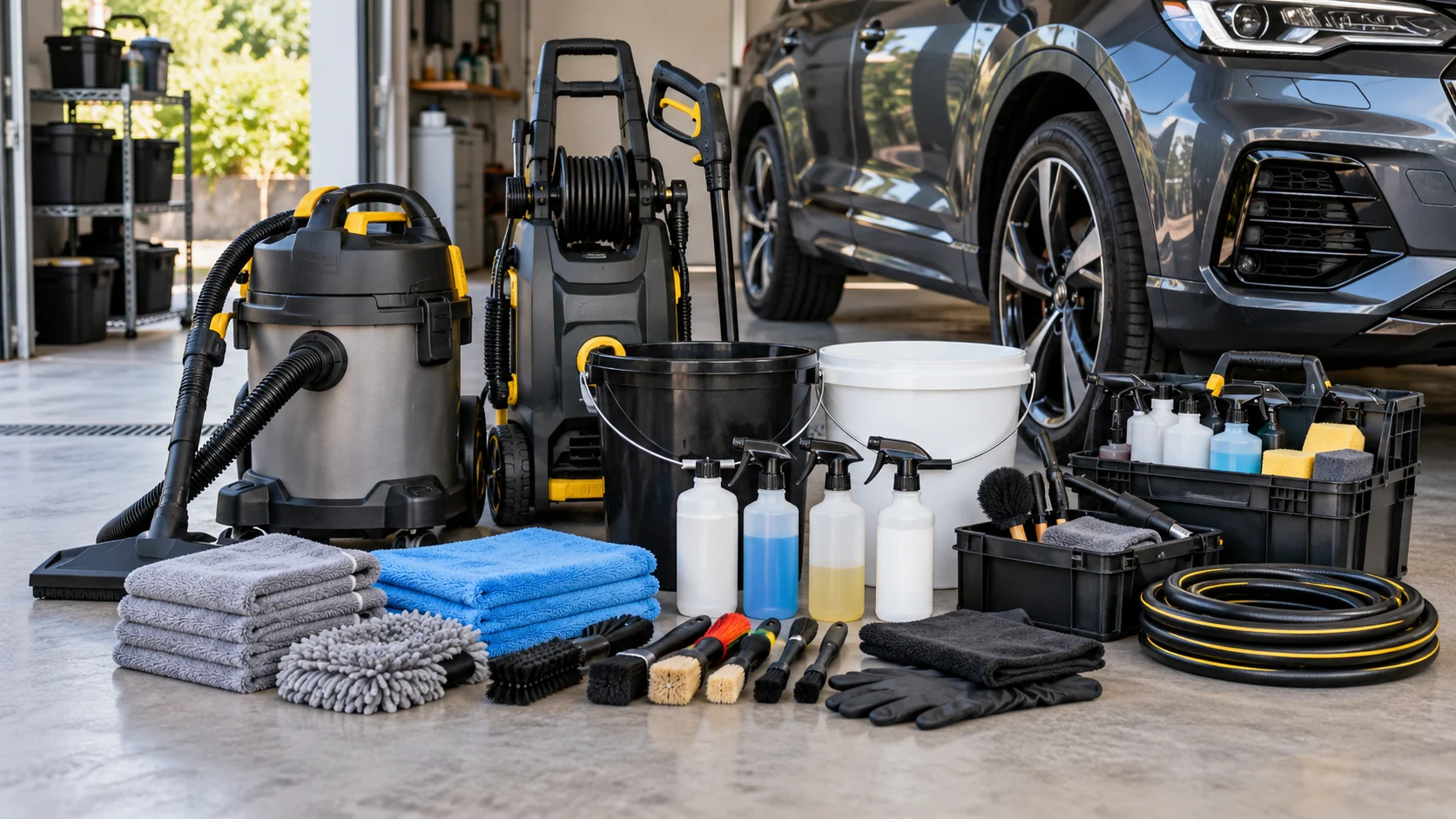
Use our mobile valeting equipment checklist to match the service to your kit. If you are starting small, the £500 mobile valeting startup guide explains why a limited offer can be more manageable than launching every service at once.
2. Count the time you normally give away
Time several practice jobs from preparation to the final tidy-up. Record each stage separately. This helps you discover whether the cleaning itself is slow or whether travelling between scattered bookings is the real problem.
| Task | Minutes |
|---|---|
| Booking messages and preparation | 10 |
| Total allocated travel | 30 |
| Setup and packing away | 20 |
| Cleaning the vehicle | 90 |
| Laundry, restocking and payment admin | 15 |
| Total working time | 165 minutes / 2.75 hours |
Allocate travel fairly across a route: do not count the same journey twice. Include the return journey or its reasonable share. Weekly marketing and bookkeeping also take time; account for them in your overall capacity rather than pretending every available hour can be sold.
If you have twenty hours available each week, you do not automatically have twenty hours of cleaning capacity. Leave room for administration, weather disruption and gaps. Pricing against a permanently full diary can make a fragile business look healthy on paper.
3. Separate your costs into useful groups
Direct booking costs include chemicals used, cloth laundry, travel fuel, parking and payment-processing costs where applicable. Estimate actual usage. A bottle's purchase price is not the cost of using a small measured amount on one car.
Shared overheads include insurance, phone and software costs, equipment servicing, storage and vehicle costs attributable to the business. Divide a realistic monthly total by a cautious number of completed bookings. Do not divide by the number you hope to achieve eventually.
Replacement and resilience money gives you room to replace worn equipment and deal with quieter periods. You can include a replacement allowance in overheads or reserve it separately; do not count the same provision twice. Your own pay must also allow for time when you are not earning, such as holidays.
For example, £240 of monthly overheads divided by twenty completed bookings equals £12 per booking. With only twelve bookings, the same overheads require £20 each. That difference explains why low introductory prices can become difficult to sustain.

4. Calculate a working price floor
A useful planning formula is: total booking hours × target pay per hour + direct costs + allocated overheads + business reserve. This is a pricing tool, not a tax calculation. Your target pay is before personal tax and other personal deductions.
Using the 2.75-hour booking above, suppose you choose a target of £20 for each working hour. That target is your assumption, not a recommended industry wage.
| Component | Calculation | Amount |
|---|---|---|
| Target payment for your time | 2.75 hours × £20 | £55 |
| Direct costs | Products, laundry and travel | £9 |
| Overhead allocation | Share of monthly costs | £12 |
| Business reserve | Additional resilience allowance | £9 |
| Illustrative total price | £55 + £9 + £12 + £9 | £85 |
At £85, subtracting the £21 of direct costs and overheads leaves £64. Reserving £9 leaves £55 for your time before personal tax. If you charged £60 for the identical job, the same calculation leaves £30, or about £10.91 per working hour.
Neither figure guarantees a sale. If local customers will not pay the sustainable price, revisit your service, travel area, working method or target customer. Quietly removing your own pay is not a lasting solution. If VAT applies to your business, adapt the calculation with your accountant and show consumers the appropriate total price.
5. Use packages customers can understand
Keep the first menu short. A maintenance interior clean, an exterior maintenance wash where you can manage wastewater appropriately, and a combined service may be enough. Only offer work that fits your skills, equipment and insurance.
Give each package a clear checklist, suitable vehicle conditions and explicit exclusions. Your internal hourly calculation helps you build the price; the customer can still receive a fixed quote. There is no need to charge less simply because your experience helps you finish efficiently.
Vehicle size affects workload, but condition can matter more. A regularly maintained estate may be easier than a small car with embedded pet hair. Ask for photographs of seats, footwells and the boot, along with the model and postcode, before confirming an unfamiliar booking.
6. Agree extra work before starting it
Heavy pet hair, excessive sand, neglected interiors and substantial stain treatment can add time. Explain how you assess these jobs and confirm any revised scope and total before work begins. Do not surprise a customer with an extra bill after completing work they never agreed to.
For uncertain work, offer an inspection or a clearly defined time-limited task with agreed expectations. Decline mould, hazardous contamination or specialist treatments outside your competence. A higher price does not make unsuitable work safe.
The CMA's price-transparency guidance explains that advertised prices should include unavoidable charges. If a total cannot reasonably be calculated in advance, explain prominently how it is calculated. A “from” price must be meaningful, with clear conditions, rather than a low headline almost nobody can obtain.
7. Make travel and equipment work for your price
A tight service area can protect earnings better than another booking on the other side of town. Group customers by location and consider a minimum booking value. Explain coverage and any applicable travel calculation clearly, then include known mandatory charges in the customer's total.
You can start with compact transport, as our valeting without a van guide explains. Avoid treating a larger vehicle or new machine as essential until real bookings demonstrate the need.
For vacuum selection, read our wet-and-dry vacuum buying guide and the Kärcher WD 2 Plus product guide. Check intended use, commercial warranty terms, attachments and replacement filters. A wet-and-dry vacuum is not a spray extractor.
The Autoglym Supreme Car Care Collection guide is another useful comparison point. Before buying a bundle, check which products your actual service needs and their cost per use. More bottles do not automatically justify a higher customer price.
8. Offer discounts only when the numbers support them
Regular maintenance bookings may take less time than neglected first visits. Two vehicles at the same address can share travel and setup. These are possible savings to measure, not automatic reasons to reduce every price.
Price the first restorative clean separately where appropriate. Offer a maintenance rate only for an agreed frequency and condition. If visits become irregular or the workload changes, reassess before the next booking. Our article on discounts for regular cleaning explores the same principle in another service business.
When someone asks for a cheaper option, reduce the scope honestly. “I can offer the smaller interior package for that budget” is more sustainable than delivering the full service at a price you already know is too low.
9. Review your first ten bookings
Record the quoted price, actual total time, costs, vehicle condition and any unexpected work. Calculate what remains after business costs, then compare it with the hours used. Look for patterns before changing the whole menu.
If pet hair repeatedly adds forty minutes, improve assessment. If driving dominates, tighten the area. If every job overruns, refine the package or timings. Keep business income and expense records too; HMRC's record-keeping guidance explains the requirements for sole traders and partnerships.
Frequently asked questions
How much should I charge for a mobile valet?
There is no single suitable price. Calculate the full time and cost for your defined service, then compare genuinely equivalent local offers. The £85 example above demonstrates a method, not a national rate.
Should I charge hourly or per vehicle?
Use an hourly target internally and give fixed package quotes where the scope is predictable. For uncertain jobs, agree the assessment, pricing basis and limits before proceeding.
Should beginners be the cheapest?
No. Start with a narrower service you can deliver well. A limited introductory offer can help test demand, but it should have clear terms and remain financially manageable.
When should I increase my prices?
Review them when costs, workload or timings change. Explain new prices before future bookings are agreed and honour existing agreed quotes unless the customer agrees to a change.
Build a service worth running
Choose one package, time it honestly and calculate your price floor before posting a price list. Then improve the offer using actual bookings. Explore the Mobile Car Valeting Business Blueprint for your next planning step, and find more ideas on our Practical Blueprint Pinterest board.
Get the Mobile Car Valeting Blueprint on Payhip
Explore the blueprint collection for guides, planners and practical worksheets.