Mindset
How to Change Your Mindset When You Feel Stuck
Recognise unhelpful patterns, check discouraging assumptions and choose a manageable next step, with a worked example and a seven-day starting plan.

Feeling stuck can be frustrating precisely because you care. You want a different job, a calmer routine, a new skill or a project of your own. Yet another week passes, and you are still thinking about where to begin.
Learning how to change your mindset when you feel stuck starts with noticing what happens between wanting something and taking action. Your next step might involve questioning an assumption, making a task smaller or asking for practical help. You do not have to feel completely confident before you begin.
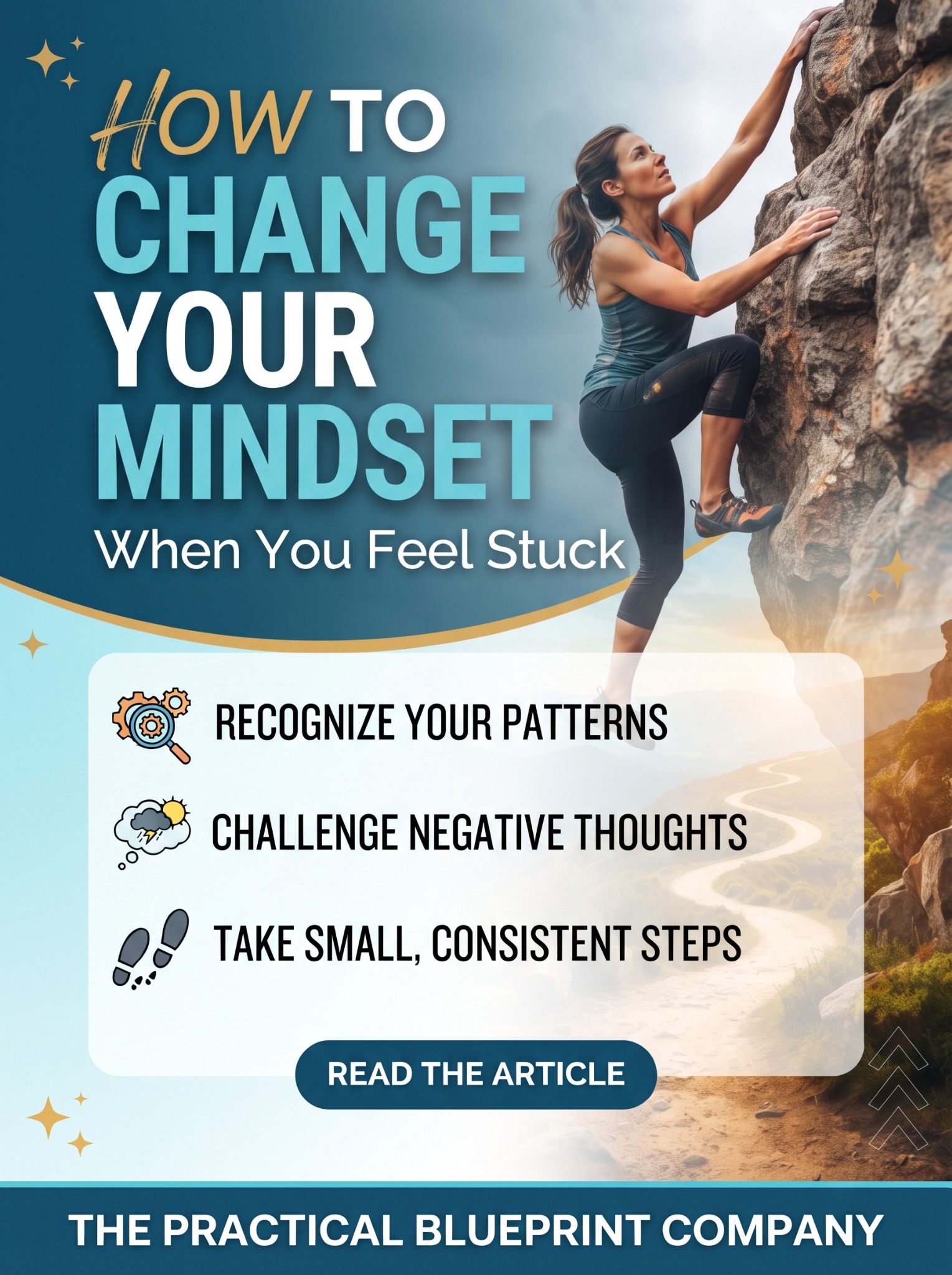
The three reminders in our Pinterest pin offer a useful starting point: recognise your patterns, challenge negative thoughts and take small, consistent steps. Here is how to make those ideas useful in everyday life.
1. Name what feels stuck
“My whole life needs to change” is an understandable feeling, but it gives you an enormous job. Start by narrowing it to one situation you can describe.
Try completing this sentence: “I feel stuck with ___ because ___, and I would like ___.” For example: “I feel stuck with learning French because I keep collecting resources without practising, and I would like to manage a short conversation.”
Then ask what kind of obstacle you are facing:
- Uncertainty: you need information before choosing.
- A practical barrier: time, money, health, access or caring responsibilities limit your options.
- A skill gap: you need teaching, practice or feedback.
- A discouraging assumption: you are treating an untested prediction as a fact.
Several may apply. A parent with no childcare does not simply need a more positive attitude. They may need a smaller commitment, a different timetable or support. Naming the obstacle helps you choose a response that fits.
2. Recognise the pattern before trying to change it
Think about the last time you intended to act but did something else. Record four things: the situation, your thought, what you did next and what happened afterwards.
A familiar pattern
Situation: You open a job advert that interests you.
Thought: “They will want someone with a better background.”
Action: You close it without checking the requirements.
Result: You avoid possible rejection, but learn nothing about whether the role could suit you.
The useful discovery is the point where you can try something different. You could read the essential criteria and highlight the ones you meet before deciding whether to apply.
Keep this observation brief. Five minutes and one example are enough. You are gathering information, rather than building a case against yourself. Watch for a practical pattern too: perhaps you always attempt demanding tasks when you are exhausted.
3. Check the thought holding you back
A thought can feel convincing without telling the whole story. “I have never done this” describes your experience. “I will never be able to do this” predicts the future.
The NHS guide to reframing unhelpful thoughts recommends noticing a thought, checking the evidence and considering another perspective. A neutral alternative can be useful; you do not have to force yourself to believe an upbeat statement.
On paper, answer these three questions:
- What do I actually know about this situation?
- What am I assuming or predicting?
- What would be a fairer statement that leaves room for action?
For example, change “I always give up” to “My last plan was difficult to maintain alongside work. I can test a shorter session.” You still acknowledge the earlier difficulty, while identifying something you can adjust.
If the obstacle is genuine, respect it. “I cannot afford this course” may be accurate. The next question could be whether a free introductory lesson would help you decide if the subject is worth pursuing later.
4. Choose one small experiment
Trying to fix everything at once makes it difficult to see what helps. Pick one action that gives you useful information, preferably without a large financial or time commitment.
A useful experiment has a clear action, a small boundary and a review point. “Explore a career change” becomes “Spend 15 minutes comparing the requirements of two real vacancies, then note one question I need answered.”
Other possibilities include:
- Practise five phrases aloud before buying another language course.
- Draft three sentences describing a service before designing a logo.
- Clear one usable surface before planning a whole-room reorganisation.
- Ask one experienced person a specific question about a project.
If your goal still feels unwieldy, our guide to turning a big project into a weekly plan can help you sort the work into manageable stages.
Define success as completing the experiment and learning from it. A conversation that reveals a course is unsuitable can still save you time and money.

5. Give the action a place in your day
“I will do it when I have time” leaves the decision open. Choose a realistic opportunity: after breakfast on Tuesday, during a quiet afternoon or before opening the television app.
Prepare what you need in advance. Leave the notebook accessible, save the relevant webpage or put the practice materials together. The aim is to reduce the number of decisions required to begin.
Add a fallback for an ordinary disruption: “If Tuesday becomes too busy, I will do the five-minute version on Wednesday.” Avoid turning the fallback into a punishment or doubling the workload after a missed session.
For a concrete example involving your home, try our 15-minute cleaning reset for an overwhelming home. Its limited scope illustrates how a clear stopping point can make a task more approachable.
6. Review what happened without judging your whole character
After your experiment, ask: What did I do? What helped? What got in the way? What would I change next time?
Suppose you planned 15 minutes of practice but managed five. That tells you something about the session, timing or task. It does not prove that you are incapable of learning.
Equally, avoid pretending every attempt worked. If you spent the session searching for materials, prepare them beforehand. If you did not understand the instructions, find a clearer explanation. If you were too tired, reconsider the timing or whether rest is the immediate priority.
You can use the reflection sheets and planner in the Mindset Bundle on Payhip to record these observations. A plain notebook works too. The value lies in using what you notice.
A seven-day plan for getting unstuck
This is a starting exercise, not a promise to change your life in a week. Keep each session short and adapt it to your circumstances.
- Day one: describe one situation that feels stuck and the change you would like.
- Day two: record a recent situation–thought–action pattern.
- Day three: separate one assumption from the facts and write a fairer alternative.
- Day four: choose a small experiment and define its finish point.
- Day five: try it at a planned time, using a smaller version if necessary.
- Day six: review what happened and identify one adjustment.
- Day seven: repeat, adapt or pause the experiment based on what you learned.
For example, someone interested in self-employment might discover that their immediate problem is an unclear service idea. Their experiment could be asking one potential customer about a recurring difficulty, rather than buying equipment. The next step follows the information they receive.
When you need support beyond a mindset exercise
Feeling stuck can accompany circumstances that a workbook cannot resolve. Practical advice, workplace adjustments, financial guidance or help from someone you trust may be more relevant than another personal goal.
If low mood lasts more than two weeks, you are struggling to cope or self-help is not helping, the NHS recommends speaking to a GP. You can seek help sooner if you need it. This article and our bundle provide educational reflection and planning tools, not therapy or a diagnosis.
Your next step can be small and still matter
Choose one situation, notice the pattern around it and test a manageable response. You do not need to settle every question about your future before doing that.
Keep the plan flexible enough to survive ordinary life. If you use printable resources, our guide to making your PDF planner work for you explains how to select useful pages and build a simple review habit. Begin with the page or action that helps today.
Frequently asked questions
What is the first step to changing your mindset?
Describe one specific situation where you feel stuck. Identify the thought, practical barrier or missing information involved, then choose one manageable action. A precise starting point is easier to work with than a demand to change everything.
How long does it take to change your mindset?
There is no fixed timetable. You might notice a useful alternative perspective quickly, while changing familiar responses takes repeated practice. Review what you are learning rather than treating 21 or 30 days as a guaranteed finish line.
Do I need to feel motivated before I start?
You can try a small, planned action while still feeling uncertain. Make the task proportionate to your energy and circumstances. Persistent exhaustion or low mood deserves attention rather than pressure to keep pushing.
What if I keep returning to negative thoughts?
Returning thoughts do not automatically mean the exercise has failed. Notice the situation and consider whether you need a different action, more support or a break from analysing it. Seek professional support if the thoughts are distressing or affecting everyday life.
What is included in the Mindset Bundle?
Seven PDFs with 121 pages including covers: the ebook, Mindset Into Action Workbook, 30-Day Small Steps Planner, Confidence and Setbacks Toolkit, Starting Something New Workbook, Quick Reference Sheets and Start Here Guide. They are for personal use, printing or digital annotation; they are not interactive fillable forms.
Explore the blueprint collection for guides, planners and practical worksheets.