
Mindset
How to Stay Positive When Your Business Grows Slowly
Notice meaningful small wins, set realistic goals, protect your energy and review slow business growth with a practical weekly reset.
You have done the work. You have planned your service, created a product or started telling people what you offer. Yet the enquiries are occasional, sales are uneven and the business feels a long way from the picture you had in your head.
Slow growth can be particularly discouraging when you are fitting a business around paid work, family responsibilities and a limited budget. Every spare hour matters. When the results are quiet, it is easy to wonder whether those hours have been wasted.
Staying positive does not mean convincing yourself that everything is fine. It means giving yourself a fair chance to understand what is happening, make useful changes and choose your next step without turning every quiet day into a judgement about your abilities.
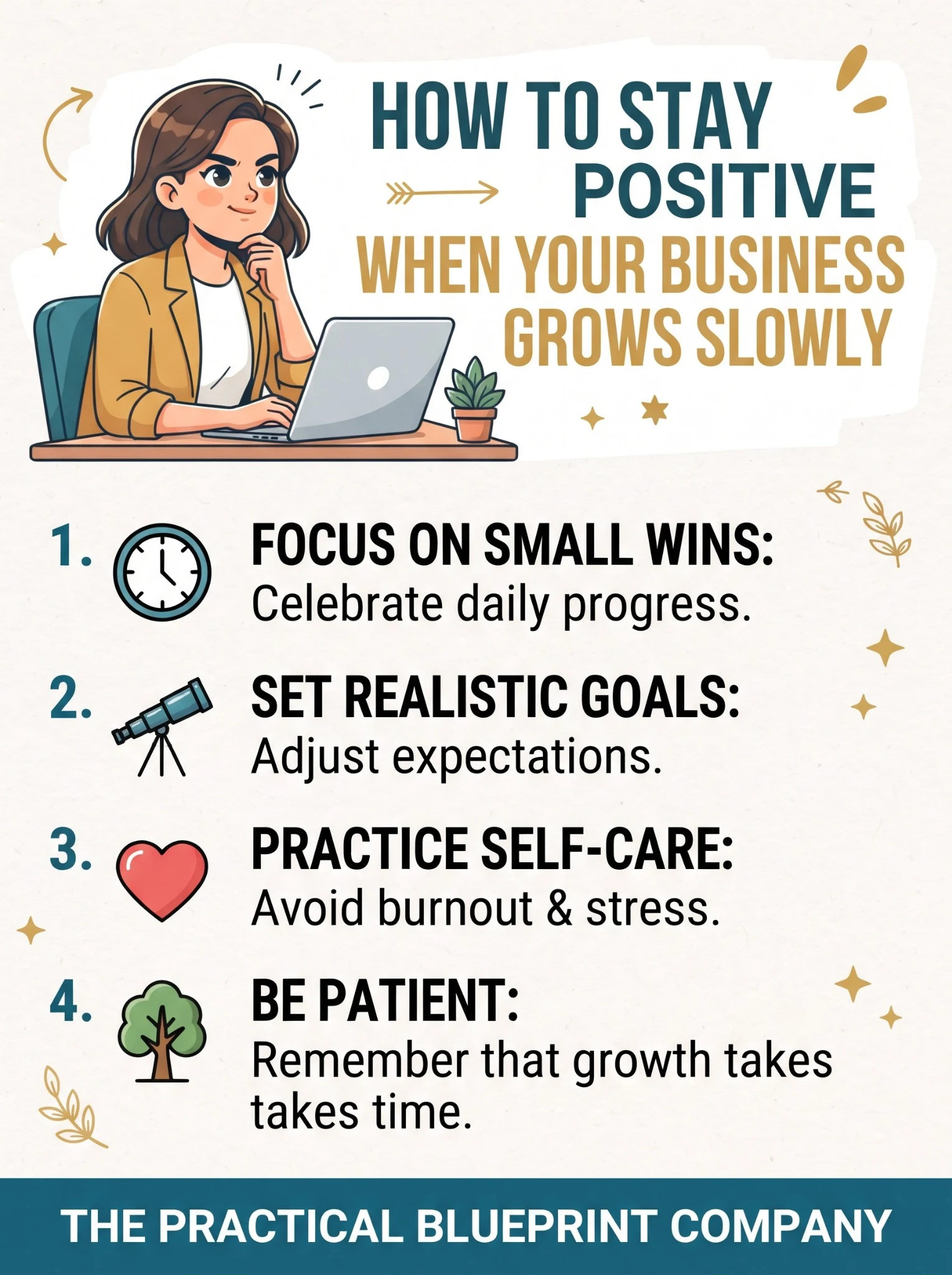
Our Pinterest image offers four helpful reminders: focus on small wins, set realistic goals, practise self-care and be patient. Here is how to turn those reminders into a practical way of working, whichever business blueprint you are following.
1. Focus on small wins that move the business forward
When sales are your only measure of progress, an early business can feel unsuccessful almost every day. Sales matter, but there are steps between starting a business and earning a dependable income from it.
A gardener might learn which local customers need regular maintenance. A cleaner might improve an enquiry reply so customers understand the service before asking for a quote. Someone selling a digital guide might discover that readers keep asking the same question, then make the answer clearer on the product page.
These are useful wins because they improve the offer, reduce uncertainty or help a potential customer take the next step. They deserve noticing even when they do not immediately produce a sale.
At the end of a working session, write down one sentence: “Today I moved the business forward by…” Be specific. “I explained what the first clean includes” tells you more than “I worked on my business”.
Also ask whether your activity had a purpose. Changing a logo repeatedly can feel productive while leaving a confusing offer untouched. A small win should help you deliver better work, understand customers or make a sensible decision.
Try a three-line progress record
Completed: I clarified the area my dog-walking service covers.
Learned: Two enquiries came from outside that area.
Next: Put the service area near the top of the enquiry page.
If it is difficult to get started at all, our guide to changing your mindset when you feel stuck explores how to make the next action manageable.
2. Set realistic goals around your actual week
The second reminder in the image is to adjust expectations. Begin with the hours and energy you can reasonably give the business.
If you have two evenings available, a plan requiring daily articles, constant social posting, a new product and several customer visits is unlikely to be comfortable. Missing that plan may reflect the size of the workload rather than a lack of commitment.
Choose one main priority for the week, then a small number of actions that support it. For example, a new cleaning business might focus on improving local enquiries. Its actions could be clarifying the service description, asking a previous customer for an honest review and preparing a helpful reply to common questions.
Separate actions from outcomes. You can control whether you send a requested quotation promptly. You cannot control whether the customer accepts it. Keep an outcome to watch, but assess your effort against actions you could actually complete.
- Action goal: improve one service page so the offer and next step are clear.
- Outcome to observe: whether suitable enquiries arrive after that change.
- Review point: a date you choose in advance to look at the response.
Keep a minimum version for a difficult week. Answering existing enquiries and finishing one useful improvement may be enough when other responsibilities need your attention. You can return to a fuller schedule when capacity allows.
For a practical example of planning around existing commitments, read how to run a gardening side hustle around a full-time job.
3. Find out what “slow” means in your business
“Nothing is happening” can describe several different problems. Perhaps too few suitable people see your offer. Perhaps people enquire but do not understand what is included. Perhaps customers buy once but have little reason to return.
Choose a few simple observations relevant to your business. A local service might record suitable enquiries, quotations and bookings. A digital-product business might record product-page visits, customer questions and purchases. The aim is to make the situation clearer, not create another demanding administration job.
Write down what you know and what remains uncertain. “Three people asked whether equipment is included” is evidence of a question worth answering. “Nobody wants my service” is a much broader conclusion that those conversations do not establish.
Look for repeated patterns, and remember that a handful of visits or enquiries gives you limited information. If you have barely shown the offer to suitable customers, there may not yet be enough response to judge it fairly.
When you do identify an obstacle, choose one practical response. Improve the unclear description, check the enquiry form or ask a willing customer what they found confusing. Positivity is easier to sustain when it leads to a useful question.
4. Practise self-care as part of your working plan
The third message in the image concerns self-care. For a small-business owner, that can begin with ordinary working boundaries: a finish time, proper breaks and periods when you are not checking for the next notification.
If the business grows slowly, the temptation is to fill every available gap with more effort. Before doing that, ask whether you have a clear task to complete. Another exhausted hour staring at statistics may not tell you anything new.
Try choosing when you will review your figures rather than reopening them whenever you feel uncertain. Keep customer response times clear and realistic. Leave space for meals, rest and relationships, including during weeks when you wish the business were further ahead.
You do not need to earn a break by reaching a sales target. Nor does taking an evening off prove that you are insufficiently committed.
The aim is a routine you can return to. If your available hours have changed, adapt the workload instead of expecting yourself to follow a plan designed for a different week.
5. Be patient, with a review date attached
The final reminder in the image is that growth takes time. Patience is helpful when it gives a reasonable experiment room to work. It is less useful when it becomes a reason to avoid looking at the results.
Before trying a change, write down what you are testing, how much time you can give it and what would count as a useful response. The appropriate review period will depend on the work. A customer conversation may reveal a misunderstanding immediately; a seasonal service may need assessment across its relevant season.
Avoid changing your audience, service description, price and promotion all at once if you hope to understand which change helped. Where practical, make a clear adjustment and keep a brief note of when you made it.
At the review, allow yourself several possible decisions: continue, refine the idea, pause it or stop. Choosing to change direction after examining the evidence can be a sensible business decision. Persistence is useful when you keep learning, not when it requires ignoring your circumstances.
Our How to Change Your Mindset — Complete Action Bundle includes a Confidence and Setbacks Toolkit and a 30-Day Small Steps Planner for readers who would like more structure for reflection and action.
6. Compare your progress with a fair starting point
Another business may have more time, an established audience, different responsibilities or years of customer relationships behind it. You may see its busy diary without knowing what it took to build one.
Use other businesses to learn from specific choices. Notice how clearly they explain a service, what customer questions they answer or how easy they make it to enquire. Then return to your own situation.
Compare your current business with an earlier version of it. Is your offer clearer? Are you quoting more consistently? Have you identified which jobs fit your skills? Are customers receiving a better experience?
Those improvements do not guarantee future income, but they give you something concrete to assess. They are a fairer basis for your next decision than comparing your first months with someone else's established operation.
7. A practical example: a quiet start to a cleaning business
Imagine a cleaner who has a few occasional bookings but hoped for regular clients by now. After another quiet week, they consider cutting every price and offering several new services.
Instead, they review the enquiries received. Several people have asked what a regular visit includes. The cleaner decides to make that explanation clearer, show the service area prominently and describe how a first visit is arranged.
For the next working period, the priority is a clearer regular-cleaning offer. They record suitable enquiries and bookings, complete the work already promised and schedule a review. They also keep their planned time off.
This does not guarantee a fuller diary. It does replace a discouraging general feeling with an identifiable problem and a manageable test. If the response remains quiet, they have a better starting point for the next question.
For help with the service itself, read what services a new domestic cleaning business should offer and what to ask before quoting for a cleaning job.
A simple weekly reset
Set aside a short review at the end of your working week. Use these five prompts:
- Notice: What useful work did I complete?
- Learn: What did customers or results tell me?
- Choose: What is the next question worth testing?
- Limit: What can realistically fit into next week's available time?
- Protect: When will I finish and take time away?
Your answer might be one improved paragraph and one customer conversation. A small, relevant plan is enough to begin with.
Keep the next step useful
You do not have to feel cheerful about every quiet week. You can acknowledge disappointment and still make a thoughtful choice about what happens next.
Return to the four reminders in the image: notice meaningful small wins, set goals that fit your circumstances, protect your energy and practise patience alongside regular review. Pick one useful action you can finish, then give yourself credit for completing it.
Frequently asked questions
Does slow growth mean my business idea is failing?
Not necessarily. Look at who has seen the offer, what response it receives and whether customers understand it. Slow growth deserves investigation, but on its own it does not explain the cause.
How can I celebrate small wins without ignoring sales?
Record useful actions and learning alongside enquiries, bookings or purchases. Notice the improvement while continuing to review whether it contributes to a workable business.
How long should I keep trying the same approach?
There is no universal deadline. Choose a review point suited to the activity, your available time and your circumstances. Decide what response would justify continuing, and give yourself permission to revise or stop.
Should I work more hours if growth is slow?
First identify what those hours would achieve. A focused improvement may be useful; repeatedly checking results without a new question may not be. Set a workload you can reasonably sustain.
Can the mindset bundle help with business setbacks?
It offers educational exercises for reflection, confidence and planning, including a setbacks toolkit and a small-steps planner. It does not guarantee business results or replace professional support.
Explore the blueprint collection for guides, planners and practical worksheets.