
Mobile Coffee Business
How to Find Your First Coffee Cart Pitch: What to Check Before You Book
Find and assess your first coffee cart pitch: footfall, event fit, facilities, permissions, competition, costs and booking terms, with a practical checklist.
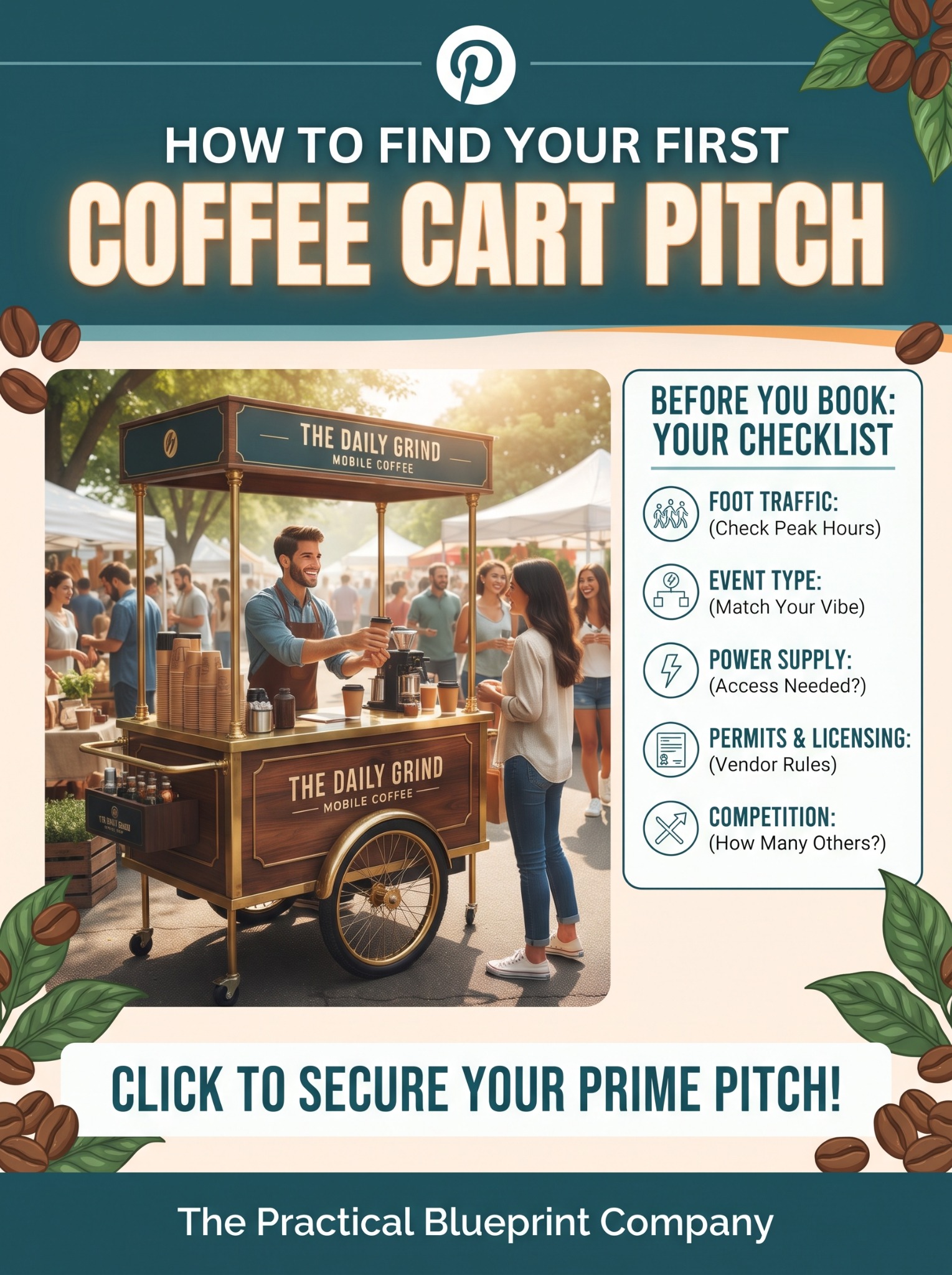
Your first coffee cart pitch should give you a manageable opportunity to serve the right customers, cover your costs and learn. A busy-looking location is only a starting point. You also need permission to trade, suitable facilities and booking terms you understand.
The five checks on our Pinterest pin—foot traffic, event type, power supply, permits and competition—provide a useful framework. Here is how to turn them into a practical search, a conversation with an organiser and a decision you can explain on paper.
UK-focused guide, checked 24 October 2026. Licensing and venue requirements vary by location. Confirm the arrangements for your specific pitch before committing. This article helps you assess opportunities; it is not a pitch-booking service.
1. Start with a pitch your setup can handle
Write a short description of what you can deliver: cart dimensions, opening menu, service capacity, power and water needs, travel radius and available dates. Be honest about what is ready and what is still being arranged.
For a first booking, a short local session with straightforward access may be easier to assess than an expensive multi-day festival. However, a small event is not automatically profitable. You still need enough relevant customers and a fee that fits the likely sales.
Use our mobile coffee equipment checklist to identify your requirements before approaching venues. It is much easier to ask for a suitable electrical supply when you already know what your complete setup needs.
2. Where to look for coffee cart pitches
Build a shortlist from council market pages, established event organisers, local business networks and venues you can visit. Search for trader applications and concession opportunities, then use the organiser’s official contact details.
| Opportunity | Who to approach | First question |
|---|---|---|
| Weekly market | Market manager or council markets team | Are coffee applications open, and is there a waiting list? |
| Community or sports event | Named organiser or venue manager | Who controls catering, and is coffee already covered? |
| Workplace or business park | Facilities manager or property manager | Can you authorise a trial, and are there catering restrictions? |
| Farm shop or visitor attraction | Owner or operations manager | Would a cart complement the existing offer? |
| Wedding or private event | Client and venue’s event coordinator | Who pays for drinks, and who approves external suppliers? |
Record the contact, dates, fee, facilities and outstanding questions in one sheet. Start with perhaps five realistic options. A shortlist you can investigate is more useful than dozens of unanswered messages.
Check the organiser independently before sending a deposit. An attractive social-media advert does not establish who controls the land or whether the event is confirmed.
3. Check foot traffic at the hours you would trade
Visit at a comparable time and day. Observe several short periods rather than relying on one busy moment. Count people passing the proposed position, note where they stop and look at the direction from which they approach.
Ask whether the advertised attendance means unique visitors, total entries across several days or a forecast. Someone entering a large event may never pass your corner. For a new event, treat predicted attendance as an assumption rather than established demand.
- Do visitors have time to stop, or are they rushing elsewhere?
- Can people see the cart and prices before joining the queue?
- Are refreshments already included in admission or provided free?
- Does the likely peak match your opening hours?
- Could a queue form without blocking access or neighbouring traders?
A commuter location might concentrate demand into a short morning window. A family event may spread it across the day. Both can work, but they create different staffing, stock and service requirements. Footfall is evidence to investigate, not a promise of coffee sales.
4. Match the event and assess competition
The pin’s advice to “match your vibe” has a practical meaning: your menu, prices and service should suit the customers’ reason for being there. A concise takeaway menu may fit a morning workplace stop; a hosted celebration may need a pre-agreed drinks package.
Ask how many traders will sell coffee, including food stalls, permanent cafés and sponsor stands. Find out where they will be positioned and whether any existing supplier has exclusive rights.
Competition alone is not a reason to reject a pitch. What matters is demand relative to the number, location and capacity of sellers. Equally, being the only coffee seller does not guarantee enough customers.
If exclusivity is offered, get its scope in writing. Does it cover espresso coffee only, all hot drinks or particular trading hours? Avoid planning sales around an informal assurance that you will be “the main coffee person”.
5. Confirm power, water and access
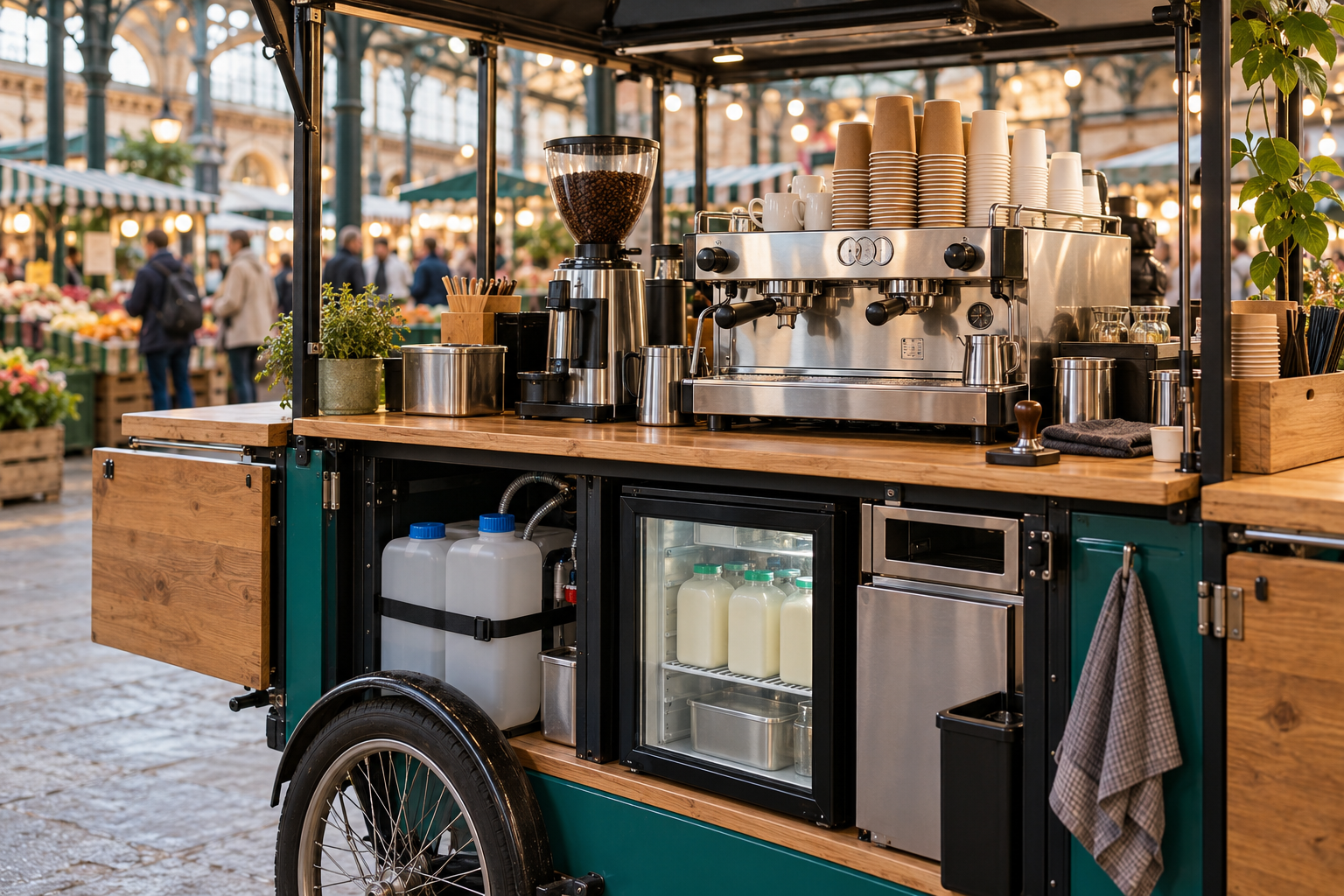
“Power available” needs more detail. Send your equipment requirements and ask what supply is allocated, where the connection is, whether it is shared and who handles safe connection and cable routing. Have compatibility assessed by a competent person; a nearby socket is not confirmation that your equipment can run safely.
Confirm potable water, handwashing arrangements, wastewater disposal, rubbish removal and access to toilets. Establish what you must bring yourself and whether the pitch provides suitable conditions for food preparation and chilled storage.
Measure the usable footprint, including doors, serving space and any canopy. Check ground conditions, steps, slopes, loading times, vehicle restrictions and where your vehicle will park. Ask about weather procedures and any restrictions on generators or fuel-powered equipment.
Test your payment connection during a visit where possible. Plan an approved backup with your payment provider. A beautiful pitch becomes difficult quickly if you cannot unload, power the equipment or take payment.
6. Separate land permission, licensing and food registration
These are different checks. An organiser accepting your application does not automatically resolve every permission your business needs.
For England and Wales, GOV.UK’s street-trading guidance directs traders to the council for the area where they intend to operate. Ask about the exact location, dates and hours. Elsewhere in the UK, check the relevant local authority’s rules.
Private land is not automatically exempt. For example, Solihull’s street-trading rules include areas accessible to the public without payment. This illustrates why you should check locally rather than assume the landowner’s agreement is sufficient. Ask separately whether planning or other permissions affect the proposed use.
Food business registration guidance requires registration at least 28 days before trading in England, Wales and Northern Ireland. The registration service asks mobile businesses to use the location where they are normally stored overnight. Confirm your circumstances with the appropriate food-safety team; for Scotland, consult your local authority or Food Standards Scotland.
Request the organiser’s trader-document list early. This may include insurance evidence, food-safety information, risk assessments and relevant equipment documentation. Check that your insurance covers the proposed activity and meets the venue’s requirements. Booking acceptance is not a substitute for your own checks.
7. Calculate what the booking needs to earn
Add the pitch fee, travel, parking, utilities and any other costs specific to attending. Then calculate what an average sale contributes after its variable costs. Include ingredients, packaging, payment fees and any sales-based commission.
Sales needed to cover attendance costs = attendance costs ÷ average contribution per sale. Round up, then add a realistic allowance for your time and business overheads.
Here is a fictional illustration, not a typical pitch price or sales forecast:
- Pitch fee: £60.
- Travel and parking: £20.
- Other attendance costs: £10.
- Total attendance costs: £90.
- Average drink price: £3.50; variable cost: £1.10; contribution: £2.40.
At those assumptions, £90 ÷ £2.40 means 38 drinks cover the £90 attendance costs. That leaves nothing for your time or general overheads. Adding an illustrative £120 allowance for those raises the target to 88 drinks: £210 ÷ £2.40, rounded up.
Count preparation, travel, setup and cleaning time as well as serving hours. Adjust for waste, menu mix, staff costs and your tax position; keep VAT treatment consistent where applicable. Compare the target with your observed demand and service capacity. If it only works under an optimistic forecast, reconsider the fee or booking.

Our beginner’s mobile coffee budget explains the wider spending plan. The Mobile Coffee Business Complete Blueprint Bundle includes pitch-profitability and pricing workbooks for testing your own figures.
8. Get the booking terms in writing
Before paying, confirm the total fee, any VAT or commission, deposit, payment deadlines and what is included. Ask what happens if the organiser cancels, severe weather intervenes or the allocated pitch changes.
Record the agreed position, trading hours, arrival and departure rules, facilities and any exclusivity. Check whether you must remain until closing even if sales are poor. For hosted events, clarify whether the client pays a fixed package, guarantees a minimum spend or expects guests to buy individually.
Save the agreed terms and invoice together. If a significant condition remains unclear, resolve it before booking.
A simple first enquiry you can adapt
Hello [name], I’m preparing a mobile coffee service offering [short menu] and would like to ask about trading at [venue/date]. My setup needs [space, power and water arrangements]. Are you accepting coffee traders? Please could you share the pitch fee, expected trading hours, catering competition, available facilities and required documents? I would also welcome a site visit before confirming. Thank you, [name/contact details].
Attach a clear photograph and menu if available. State your readiness accurately, including anything still pending. A specific, concise enquiry helps the organiser judge whether you fit.
Your final booking checklist
- You have identified the authorised organiser and exact position.
- You have assessed relevant footfall, competition and likely demand.
- Your setup fits, with workable access, utilities and hygiene arrangements.
- Permissions, registration and required documents are resolved.
- The sales target is plausible and the downside affordable.
- Fees, cancellation rules and operating terms are recorded.
After the first session, record sales by hour, waste, total costs and total working time. Review what actually happened before committing to a series of dates. A first pitch is also a test of your assumptions.
Frequently asked questions
Can I put a coffee cart anywhere on private land?
No. Obtain the authorised landholder’s agreement and check local licensing, planning and other relevant requirements. Public access can affect street-trading rules even on privately owned land.
How much should I pay for a coffee pitch?
There is no universal sensible fee. Compare the complete attendance cost with cautious sales assumptions, your contribution per sale and the amount needed for your time and overheads.
Is a market better than a private event?
It depends on the terms. A market involves uncertain customer purchases; a private event may offer an agreed package but introduces service commitments. Assess the specific booking rather than the label.
Should I book several dates immediately?
A trial can reveal access problems, demand and workload before a longer commitment. If a block booking is required, calculate the total exposure and understand cancellation terms first.
Plan your first pitch with the complete blueprint bundle
The Mobile Coffee Business Complete Blueprint Bundle brings together the 82-page ebook, editable templates, financial workbooks and event-booking resources. Use it to organise enquiries, compare pitch costs and prepare the routines behind your first service.
Replace the example figures with your own research, work through the outstanding questions and choose a booking your business can realistically deliver.
Get the Mobile Coffee Business Bundle on Payhip
Explore the blueprint collection for guides, planners and practical worksheets.