Careers & Job Search
Using AI to Improve a Job Application Without Inventing Experience
Practical prompts and examples for improving your CV, covering letter and interview preparation while keeping every claim accurate and authentically yours.

AI can help you turn a muddled paragraph into a clearer explanation of your experience. It can suggest a better structure, ask useful questions and help you practise talking about your work. The danger comes when a polished sentence quietly becomes a claim you cannot support.
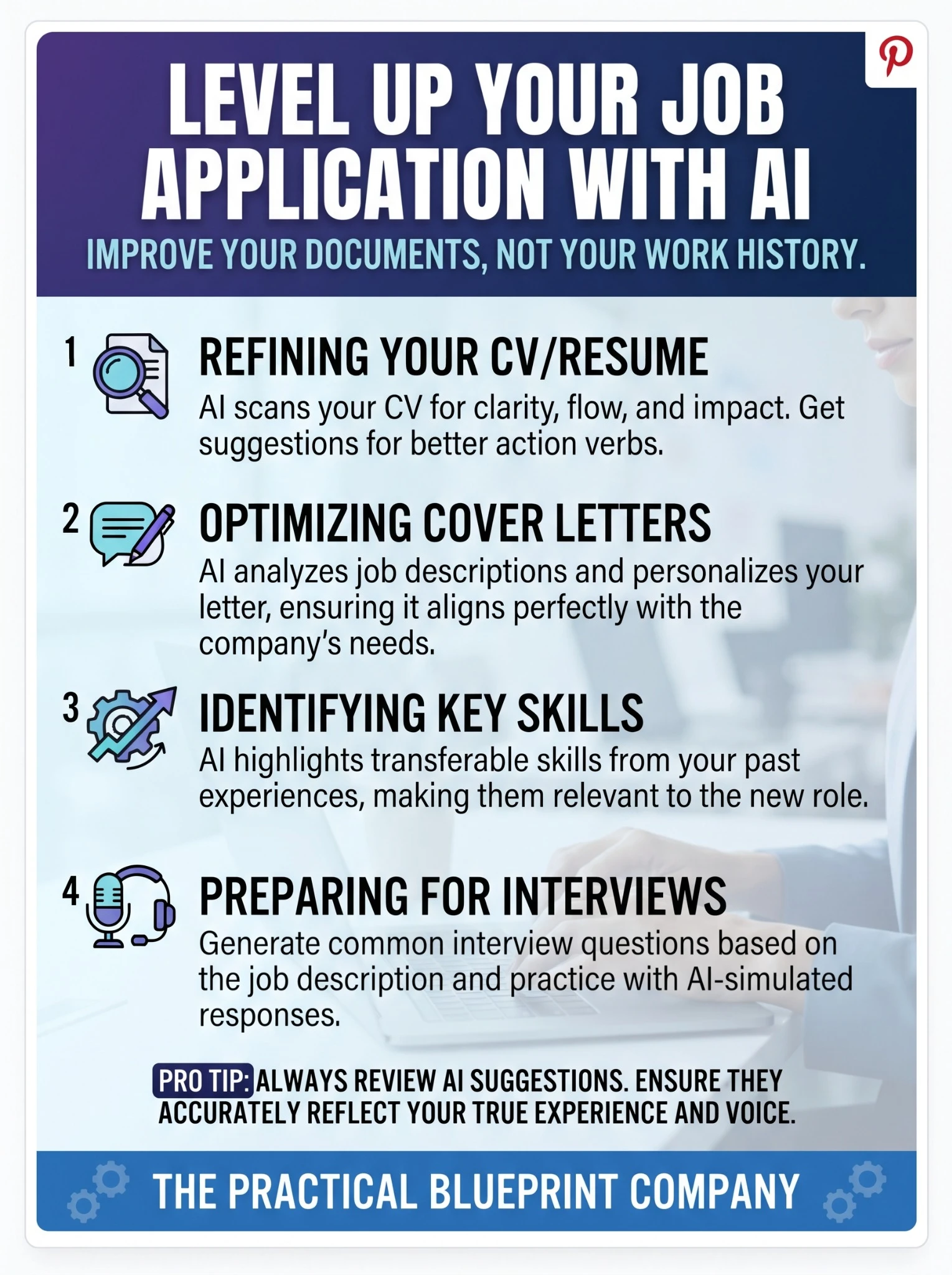
Our Pinterest pin puts the principle neatly: “Improve your documents, not your work history.” That is the right starting point for using AI on a CV, covering letter or supporting statement.
You do not need an impressive-sounding fictional career. You need an accurate application that makes your relevant experience easy to understand. This guide shows how to use AI for that purpose, with original examples and prompts you can adapt.
Start with the employer’s rules
Read the vacancy instructions before using AI. Permission to get help with wording does not automatically extend to an assessment or interview. Follow any requirements about independent work and disclosure, and ask the recruiter if the instructions are unclear.
For example, the Civil Service’s candidate guidance allows help with clarity and interview preparation, but prohibits invented experience, AI-completed assessments and AI-generated answers during interviews. That is one employer’s guidance, not a universal policy for every vacancy.
1. Build a factual evidence sheet first
Before asking for a rewrite, create a short record of what you actually did. Include your job title, dates, responsibilities, tools used, relevant training and two or three examples of handling a problem. Add the outcome where you genuinely know it.
Keep the detail ordinary and specific. “Checked the appointment diary each morning and called customers when times changed” gives an editor much more to work with than “excellent organisational skills”.
Separate personal contributions from team achievements. If your department introduced a new system and you helped colleagues use it, say that. Do not turn it into “led the organisation’s digital transformation”.
Volunteering, study and caring responsibilities can supply relevant examples too, provided you identify the context honestly. They do not need to be disguised as paid employment. If you are changing direction, our guide to choosing your next career direction after 50 can help you decide which experience matters for the work you want.
2. Refine your CV without inflating your role
The pin suggests improving clarity, flow and action verbs. All three can help, but a stronger verb must still describe the responsibility you held. “Supported”, “checked” and “organised” can be precise, useful words. Replacing them with “directed”, “transformed” or “spearheaded” may change the meaning.
Here are illustrative examples. Use a revised sentence only when its details match your own experience.
| Original fact | Clearer wording | Unsupported exaggeration |
|---|---|---|
| I updated the appointment diary and called customers about changes. | Maintained the appointment diary and contacted customers about schedule changes. | Designed a scheduling system that improved efficiency by 35%. |
| I showed two new colleagues how to use the till. | Helped two new colleagues learn the till procedures. | Managed staff training across the business. |
| I checked deliveries against order sheets and reported missing items. | Checked incoming deliveries against orders and reported discrepancies. | Eliminated stock losses through strategic supply-chain management. |
The middle column is more readable without introducing a new achievement. The final column adds outcomes, authority or scale that the original facts do not establish.
Try this prompt on one paragraph at a time:
Rewrite the paragraph below in clear UK English for a CV. Use only the facts I provide. Preserve my level of responsibility. Do not add results, numbers, qualifications, software skills or management duties. List any questions separately instead of filling gaps. Show the original and revised versions side by side.
Compare them sentence by sentence. If a claim becomes broader, narrow it again. Our CV guide for over-50 career changers offers further help with selecting relevant experience and presenting a longer work history clearly.
3. Match real evidence to the job description
Tailoring means bringing relevant evidence forward. It does not mean adopting every skill mentioned in the advert.
Make a three-column list: requirement, evidence you have, and questions or gaps. If the employer asks for customer communication, your appointment calls may be relevant. If it asks for experience with a particular database you have never used, that remains a gap.
Compare this job description with my factual evidence sheet. For each requirement, quote the relevant evidence I supplied or write “no evidence provided”. Distinguish direct experience from potentially transferable experience. Do not assume that a job title proves a skill. Ask me questions where more detail is needed.
For example, organising a community event might demonstrate coordination if you booked the room, managed responses and kept people informed. It does not automatically establish professional project-management expertise.
Use the employer’s terminology where it accurately describes your work. Avoid copying a string of keywords into your profile merely because they appear in the advert. An application should explain the connection, not leave the reader guessing.
AI cannot promise that your CV will pass an applicant tracking system or secure an interview. Concentrate on relevant evidence, clear headings and the requested file format rather than chasing a supposed universal score.
4. Improve the covering letter while keeping your voice
A covering letter should explain why this role interests you and which parts of your experience support your application. Start with your own rough notes, even if they are incomplete sentences.
Choose two useful examples instead of repeating your entire CV. Perhaps you handled enquiries in a busy setting and kept accurate records. Explain those contributions in straightforward language rather than announcing that you are a “visionary, results-driven professional”.
Help me organise these notes into a concise covering letter for this vacancy. Use only my stated reasons for applying and the evidence supplied. Keep a natural, professional tone. Do not invent enthusiasm, company facts or achievements. Mark anything requiring confirmation and explain what you changed.
Check any employer information against its own website and the vacancy. Read the letter aloud. If a sentence sounds unlike you, simplify it until you could comfortably say it to an interviewer.
For a supporting statement, follow the actual criteria and word limit. Ask AI to identify repetition or unclear passages rather than padding the response with additional claims.
5. Practise interviews using your own examples
The pin’s fourth suggestion is interview preparation. A useful approach is to ask for one practice question, answer it yourself and then request feedback on clarity.
Use this job description to ask one practice interview question at a time. Wait for my answer. Then identify unclear points, missing context and claims that need evidence. Ask follow-up questions rather than inventing a better story for me. These are practice questions, not predictions of the actual interview.
You can organise an example using situation, task, action and result. Describe what was happening, what you needed to do, what you personally did and what followed. If the outcome was not measured, explain the observed result without manufacturing a percentage.
Practise follow-up questions such as “What did you do yourself?” and “How do you know that helped?” If you cannot explain a sentence from your application, review it before submitting. Prepare beforehand and follow the employer’s rules during the actual interview or assessment.

Handle missing figures and private details carefully
Do not ask AI to estimate achievements you never measured. “Improved customer satisfaction by 40%” needs a basis you can explain. A precise account of your actions is better than an impressive unsupported statistic.
For this editing workflow, make a separate, anonymised copy of your notes. Remove your address, telephone number, referee details and unnecessary identifiers. Never paste confidential customer records, patient information or internal documents into an external tool simply to improve an example.
Use placeholders such as “[employer]” and restore appropriate details in your final document. Check the tool’s privacy settings and terms before sharing information. The government’s JobHelp AI guide also emphasises checking suggestions, retaining your personality and taking care with personal information.
A final check before you submit
- Facts: Are job titles, dates, qualifications and software skills correct?
- Responsibility: Does the wording distinguish helping, coordinating and leading?
- Evidence: Can you explain each achievement and every number?
- Relevance: Have you answered the actual criteria?
- Voice: Does the writing sound natural when read aloud?
- Instructions: Have you followed AI rules, word limits and file requirements?
- Finish: Have you removed placeholders, checked the employer’s name and opened the final attachment?
Keep the version you submit alongside the advert so you can prepare consistently for an interview. Stop editing once the application is accurate, relevant and readable; repeated rewrites can strip away useful detail.
Frequently asked questions
Is using AI for a job application dishonest?
Editing support can be appropriate where the employer permits it. The important questions are whether the content remains truthful and whether you have followed the application rules.
What if AI adds an achievement that sounds plausible?
Remove it unless you can verify it from your own experience. Plausibility is not evidence. Ask the tool to identify unsupported additions, then check the result yourself.
Can AI help if I have little paid experience?
Yes. It can help you examine relevant study, volunteering or personal projects. Label the context honestly and explain your contribution without presenting it as employment you did not have.
Should I disclose that I used AI?
Follow the employer’s instructions and answer any question about assistance honestly. If the rules are unclear, ask the recruiter rather than assuming permission.
Should I buy an AI subscription to improve my CV?
Start by identifying the editing help you need. Paying for a tool is not a prerequisite for assembling evidence or writing clearly, and no subscription guarantees a successful application.
Make your next application easier to explain
Choose one vacancy, gather your real examples and improve one section at a time. Keep the pin’s reminder beside you: review suggestions so they reflect your experience and voice. You can find more ideas on our Practical Blueprints Pinterest board.
Explore the blueprint collection for guides, planners and practical worksheets.