
Gardening Business Startup
How Much Should a Self-Employed Gardener Charge Per Hour in the UK?
A practical UK guide to calculating a sustainable gardening rate, covering billable hours, travel, tools, waste, minimum charges and fixed-price quotes.

A self-employed gardener in the UK will often see customer-facing prices anywhere from roughly £25 to £45 an hour for general garden maintenance, with lower and higher figures both possible. But the right rate is not the national average. It is the price that covers your working time, travelling, equipment, waste, administration, quieter periods and a reasonable profit.
For many new sole traders offering routine mowing, weeding, pruning and general maintenance, £30–£40 per billable hour is a sensible range to investigate locally in 2026. It is a starting point for research—not a rate to copy blindly.
Calculate your own minimum sustainable rate first. Then compare it with gardeners offering similar services in your area. If the market will not support your calculated figure, change the service, customer, route or costs rather than quietly working for less than the business needs.
Would you prefer to work this out with ready-made tools? The Gardening Business Startup Bundle includes an hourly-rate calculator, job-pricing worksheet, service price-list builder, income-target planner and editable business tracker.
Get the complete gardening business bundle — £9.99 on Payhip (opens in a new tab)What do self-employed gardeners charge in the UK?
Published consumer guides show a wide market. Checkatrade’s 2026 gardener guide gives a broad range of about £15–£45 per hour, while its garden-maintenance guide uses roughly £30 an hour for routine work. MyBuilder places many general gardeners around £20–£40 per hour, depending on the location and work.
Experienced professional gardeners may need considerably more. The Professional Gardeners’ Guild publishes regional self-employed rate guidance, and the Gardeners Guild’s 2026 member survey implies a much higher hourly target for a qualified gardener with long experience. The difference is useful: “gardening” can mean a quick lawn cut, skilled pruning, border management, planting plans or a complete transformation.
| Type of work | Indicative research range | What changes the price |
|---|---|---|
| Routine garden maintenance | Often £25–£40 per hour | Region, frequency, equipment, travel and garden condition |
| Experienced or skilled maintenance | Often £35–£50+ per hour | Plant knowledge, pruning skill, reliability and specialist tools |
| One-off clearance or difficult work | Usually quoted by the job or at a higher rate | Access, waste, machinery, hazards, labour and uncertainty |
| Landscaping or specialist services | Price separately | Materials, design, qualifications, subcontractors and project risk |
These are research ranges, not recommended prices. Compare like with like in your postcode and make clear whether your figure includes VAT, green-waste removal, machinery, materials or more than one worker.
Calculate your minimum sustainable hourly rate
Begin with the money the business must produce over a year. Add your operating costs and an allowance for profit, emergencies and reinvestment. Divide the total by the hours you can realistically invoice to customers.
Basic hourly-rate formula
(Desired owner income + annual business overheads + profit and resilience allowance) ÷ annual billable hours = minimum average revenue per billable hour
Your desired income is not the same as the business’s sales. Sales must also pay for the van or car, fuel, insurance, tools, repairs, protective equipment, phone, advertising and uncharged working time. Money set aside for Income Tax or National Insurance is not profit.
The National Living Wage for an employee aged 21 or over is £12.71 an hour from April 2026. That does not set a self-employed gardener’s customer rate. A business price must carry costs and risks that an employee’s wage does not.

Do not divide by every hour you work
A gardener might work 40 hours in a busy week but invoice only 25 or 30. The rest can disappear into travel, loading and cleaning tools, visiting new gardens, preparing quotes, buying materials, bookkeeping, marketing and weather delays.
Start cautiously. For example, 30 billable hours across 46 working weeks gives 1,380 billable hours a year. A new business with gaps in the diary may achieve less. A compact round of recurring customers may eventually achieve more.
This is why a gardener who wants the equivalent of £18 an hour personally cannot simply charge £18. If only two-thirds of working time is billable, £18 of owner income already requires £27 of revenue for each invoiced hour—before business costs and profit.
Include the real cost of running the service
List costs using actual quotes and receipts wherever possible. Review them regularly rather than relying on a startup guess.
- Vehicle and travel: fuel or electricity, servicing, insurance, tax, depreciation, parking and time between gardens.
- Tools and machinery: purchase, servicing, blades, line, fuel, batteries, repairs and eventual replacement.
- Protection: suitable insurance, boots, gloves, eye and hearing protection, training and professional advice.
- Administration: phone, website, banking, software, printing, bookkeeping and time spent quoting.
- Waste: bags, loading time, transport and lawful disposal. If you carry customers’ green waste, check the current waste-carrier registration requirements.
- Resilience: rain-affected days, cancellations, sickness, holidays, seasonal gaps and equipment failure.
HMRC’s simplified vehicle expense rate for cars and goods vehicles is 55p per business mile for the first 10,000 miles in the 2026–27 tax year, then 25p. That is a tax calculation method, not automatically the travel price you should quote, but it is a useful reminder that business mileage costs far more than fuel alone.
A worked gardener hourly-rate example
Imagine you want the business to produce £27,600 a year for your work before personal tax. Your annual overhead budget is £8,400, and you want £4,000 for profit, replacement equipment and resilience. You expect 1,380 billable hours.
(£27,600 + £8,400 + £4,000) ÷ 1,380 = £28.99
Your calculated floor is about £29 per billable hour. Charging exactly £29 leaves little room if your billable hours fall short or costs rise, so you might test a standard rate of £32–£35 for routine work and quote waste, materials or unusual machinery separately.
Now test the result against three questions:
- Do comparable, insured gardeners locally charge within reach of this figure?
- Can you demonstrate reliability, clear scope and a professional service?
- Can you improve your route or service mix if the figure feels too high for your intended customers?
The calculators inside the Gardening Business Startup Bundle let you change the costs, income target and billable hours rather than relying on one example.
Price with your own figures. Use the editable hourly-rate calculator, individual job-pricing sheet and monthly income-target planner to see what each billable hour and customer must contribute.
Download the full startup toolkit — £9.99 from Payhip (opens in a new tab)Turn the hourly rate into customer-friendly prices
Your calculated rate is primarily an internal decision tool. Customers may see an hourly rate, a minimum visit, a day rate, a recurring package or a fixed quotation.
Use a minimum visit
A one-hour job can occupy far more than one hour once travel, loading and messages are counted. A two-hour minimum, a call-out minimum or a fixed visit price protects short bookings. State it before accepting the job.
Create recurring maintenance prices
A predictable fortnightly garden may cost less per visit than irregular work because the condition, route and workload are easier to plan. Define what is included, how often you attend, seasonal changes and how additional work will be approved.
Charge direct costs separately
Plants, soil improver, hired machinery, parking and substantial waste disposal should not quietly consume the labour margin. List them clearly or state the allowance included in the quote.
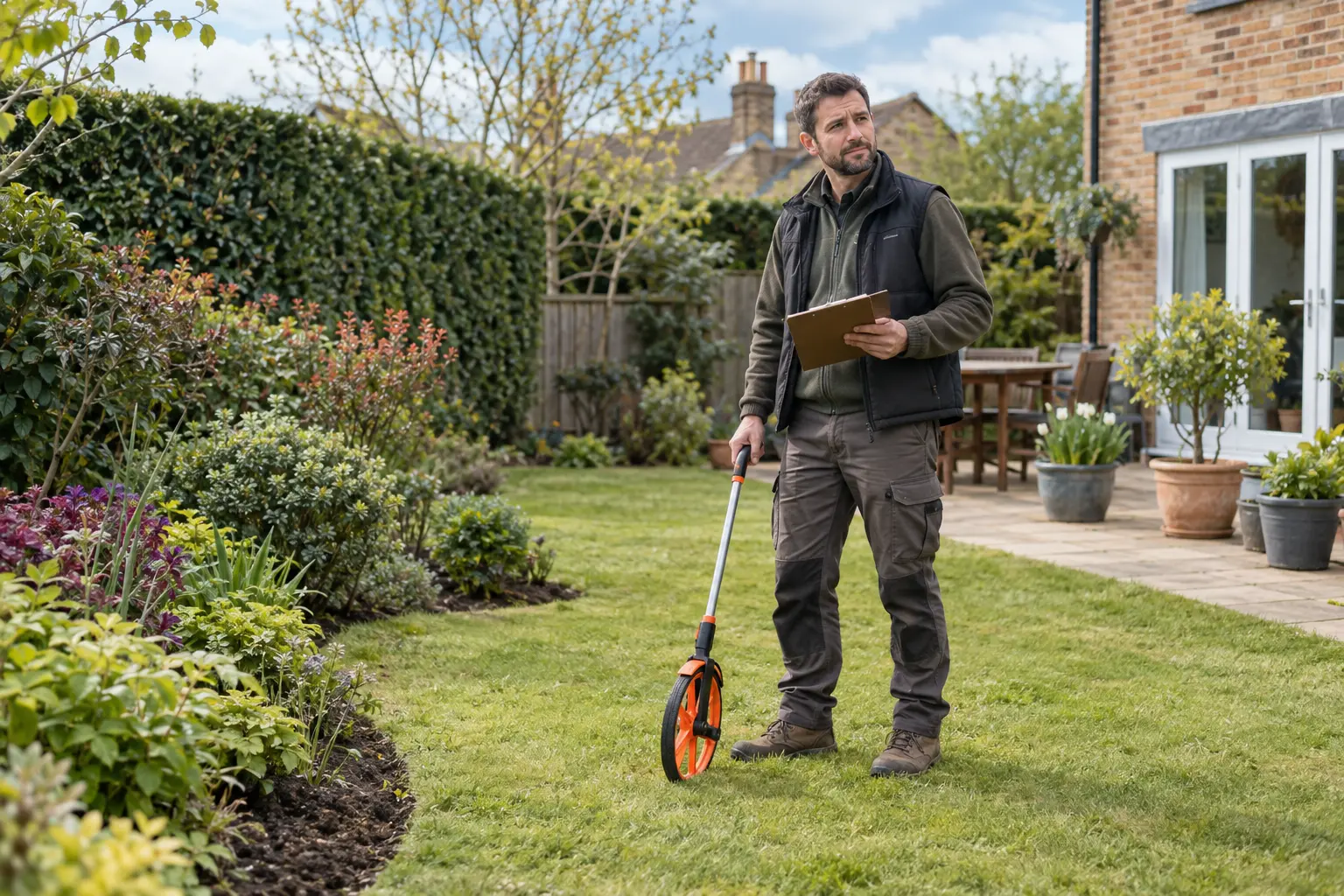
Hourly rate or fixed price—which should you use?
Hourly pricing suits open-ended maintenance, priority lists and jobs where the full condition is difficult to see. Tell the customer the rate per person, likely time, minimum visit and what happens if more time is needed.
A fixed quote suits a clearly defined hedge cut, clearance, lawn renovation or planting job. Estimate the labour hours using your internal rate, then add materials, disposal, hired equipment and an allowance for genuine uncertainty.
Simple fixed-job formula
Estimated labour hours × target hourly revenue + direct job costs + justified contingency = customer quote
Walk the garden before larger work. Check access, slopes, steps, parking, power, water, pets, fragile areas, nesting wildlife, height, waste volume and the expected finish. Write down exclusions. Specialist tree work, pesticides, construction and other higher-risk services may require skills, insurance or legal checks beyond general maintenance.
If you also want a broader example of price-floor thinking, read our guide to pricing a cleaning job without undervaluing your time. The industry is different, but the principles of billable capacity, clear scope and reviewing actual job time transfer well.
Review the rate using real jobs
For the first eight to twelve weeks, record the quoted hours, actual on-site time, travel, waste, materials and total payment for each job. Patterns will quickly show which services and areas are worthwhile.
Raise or restructure the price when costs increase materially, the scope has grown, the customer is outside your efficient route, or your records show that a service repeatedly misses its target. Give regular customers reasonable written notice. You can offer a smaller scope or different frequency, but do not preserve an unsustainable arrangement through silence.
Once your number is sound, use our weekly planning method to turn the launch into a small set of actions: calculate the rate, research local competitors, define three core services, prepare a quote template and approach the first prospective customers.
Quick pricing checklist
- I have calculated a rate from my own income goal and business costs.
- I divided by realistic billable hours, not every hour worked.
- I researched comparable local gardeners and services.
- I have a minimum visit or call-out policy.
- Travel, waste, materials and hired machinery are accounted for.
- The customer knows whether the price is hourly, estimated or fixed.
- I inspect larger or uncertain jobs before quoting.
- I record actual time and costs after the work.
- I will review prices at least annually and when costs change.
Frequently asked questions
Is £25 an hour enough for a self-employed gardener?
It may be enough for a low-cost, tightly routed service with modest overheads, but it may be unsustainable once travel, tools, insurance, administration and uncharged time are included. Calculate your own price floor before deciding.
Should a gardener charge for travelling time?
You can build normal local travel into the rate, use service zones, set a minimum visit or add a clear charge outside your core area. Whatever method you choose, it should cover the cost and time without surprising the customer.
Should green-waste removal be included?
Small amounts may be included in a defined service, but significant waste should usually be priced separately. Allow for loading, transport, disposal charges and the current legal requirements for carrying customers’ waste.
What should two gardeners charge?
Price the total labour, not just the clock time. Two gardeners working for three hours create six labour hours. A team may finish sooner, but wages, employment or subcontractor costs, insurance and equipment still need to be covered.
How often should I increase my gardening rates?
Review them at least once a year and whenever fuel, insurance, disposal, wages or equipment costs change significantly. Use your job records to identify services that need an earlier adjustment.
Price with confidence. Quote clearly. Build sustainably.
Start your gardening business with the figures and paperwork ready
The Gardening Business Startup Bundle combines a 112-page ebook with 25 printable resources, five editable Word workbooks and an eight-tab Excel business tracker.
Use it to calculate your rate, price jobs, set an income target, assess gardens, prepare quotations, organise customers and plan your first 30 days.
Buy the Gardening Business Startup Bundle — £9.99 on Payhip (opens in a new tab)Guidance checked September 2026. Price ranges are broad market indicators, not guaranteed earnings or recommended fees. This article provides general business information, not tax, legal, accounting, insurance, waste or health-and-safety advice. Confirm current requirements with GOV.UK and appropriately qualified advisers.
Explore the blueprint collection for guides, planners and practical worksheets.