
Cleaning Business Startup
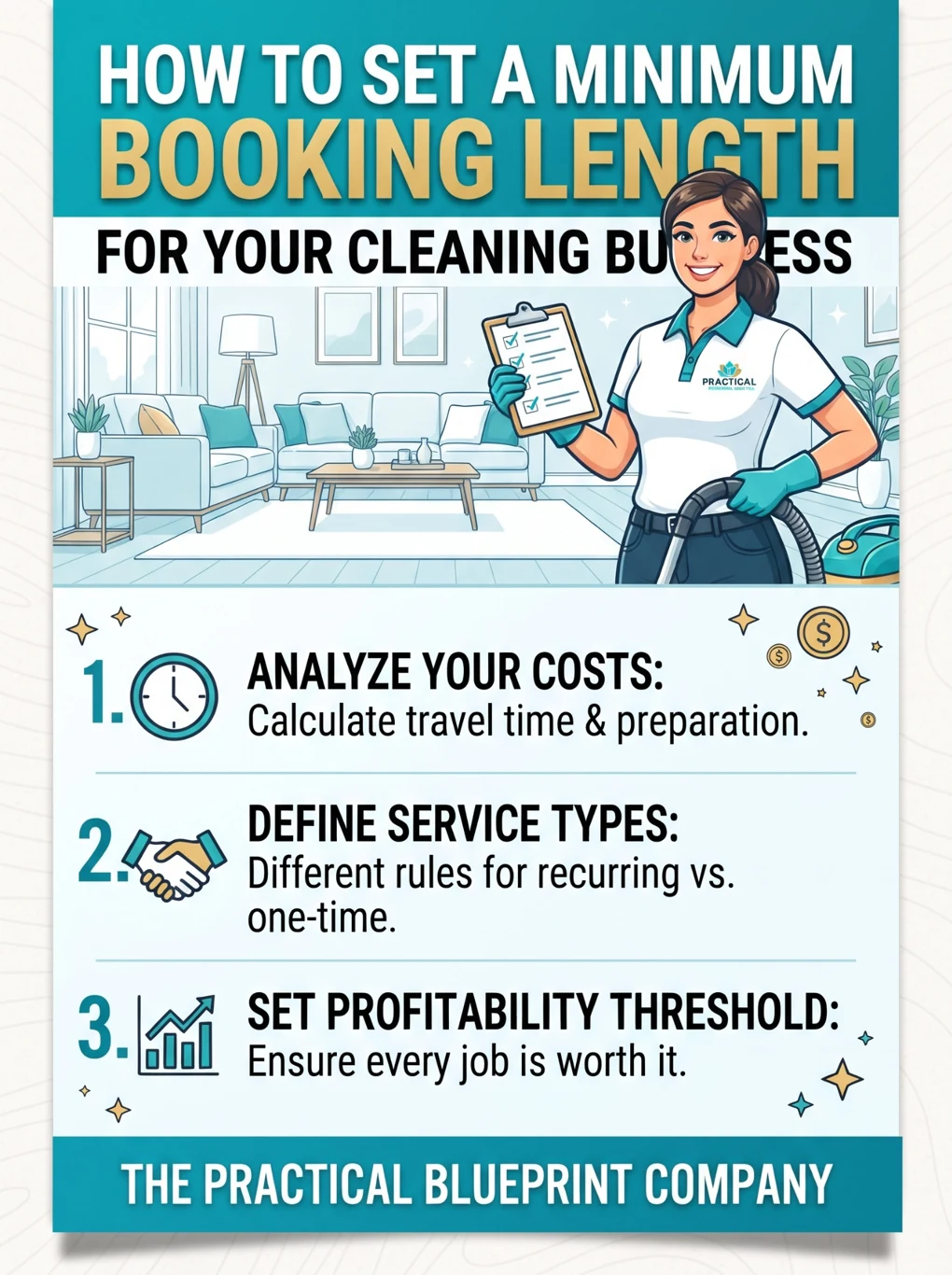
How to Set a Minimum Booking Length for Your Cleaning Business
Calculate a sensible minimum cleaning visit using travel, costs and working time, with worked examples, customer wording and a practical checklist.
A customer asks whether you can pop round for an hour to clean a bathroom and kitchen. The house is twenty minutes away, parking can be awkward, and you will need to unload equipment, discuss priorities and send an invoice afterwards. The paid hour is only part of the commitment.
A minimum booking length helps you build a workable day without squeezing every spare minute out of yourself. It gives customers a clear starting point and allows enough time to deliver a useful service. But choosing two or three hours simply because another cleaner does so can leave you with the wrong rule for your business.
The right minimum depends on your costs, travel area, service and working capacity. Here is a practical way to calculate it, explain it and review it as your cleaning business grows.
1. Decide whether you mean time or money
A minimum booking length is the shortest cleaning session you offer. For example, you might offer regular domestic cleaning from two hours per visit, with one cleaner attending.
A minimum booking charge is the smallest price you accept for a visit. A clearly described small-job package might cost £55 even where the agreed work takes less than two hours. That does not mean you should describe it as two hours of cleaning if two hours are not being provided.
These approaches can both be useful, but customers need to understand which they are buying. If you sell time, explain the session length and priorities. If you sell a fixed-price service, specify the work included and how changes are agreed.
Also distinguish elapsed time from labour-hours. Two cleaners working for one hour provide two labour-hours, but the customer sees a one-hour visit. Your quotation should say how many cleaners attend, the expected visit length and the total price.
2. Count the whole booking
Write down what happens before, during and after a typical job. Include allocated travel time, parking, unloading, setup, cleaning, packing away and job-specific messages or invoicing. Allocate shared travel sensibly across a route rather than charging the same journey twice in your calculations.
Then list the costs associated with providing that work:
- Cleaning products, laundry and other consumables.
- Vehicle running costs and parking.
- Equipment maintenance and replacement.
- Insurance, software and general administration.
- Payment fees where relevant.
Some costs vary by visit; others need spreading across realistic paid work. If you allocate monthly insurance to each booking, do not also include the full monthly bill in every job calculation. Our guide to pricing a cleaning job without undervaluing your time explains the wider pricing picture.
For a solo owner, the money left after business costs still has to support personal income, tax provision, time off and business resilience. It is not automatically disposable take-home pay.
3. Compare one, two and three hours
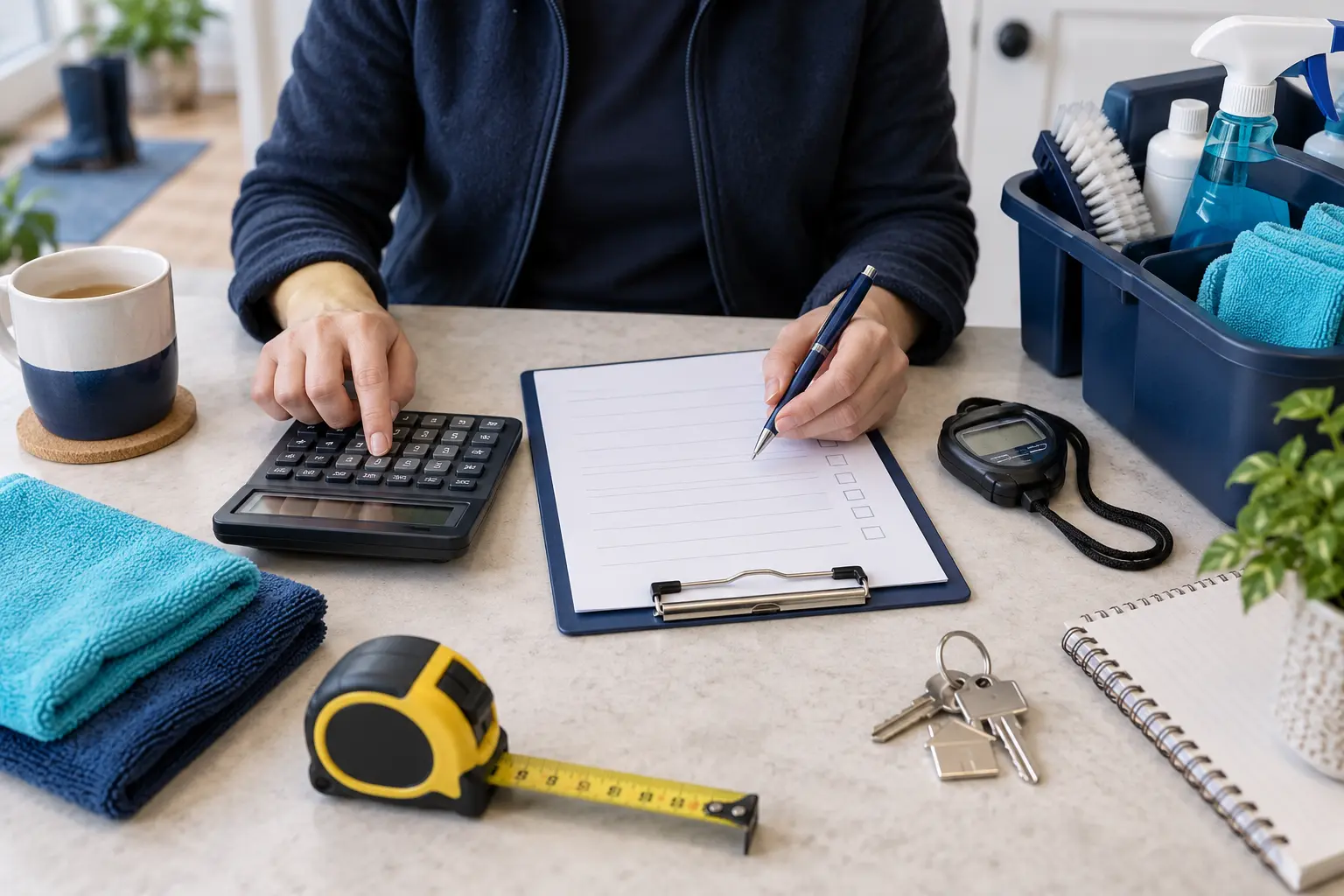
Consider an illustrative solo-cleaner example, not a recommended market rate. The customer price is £25 per cleaning hour. Each visit uses another 45 minutes for allocated travel, setup and administration. Allow £6 per visit for travel and an allocated share of overheads, plus £2 per cleaning hour for consumables and laundry. Assume the business is not VAT registered.
| Cleaning time | Revenue | Modelled costs | Total working time | Amount remaining per total working hour |
|---|---|---|---|---|
| 1 hour | £25 | £8 | 1 hour 45 minutes | £9.71 |
| 2 hours | £50 | £10 | 2 hours 45 minutes | £14.55 |
| 3 hours | £75 | £12 | 3 hours 45 minutes | £16.80 |
For the two-hour booking, the calculation is (£50 − £10) ÷ 2.75 hours = approximately £14.55. The table shows what remains after the stated costs, before personal tax and any costs omitted from the model. It is not an employee wage or a guaranteed profit.
Longer bookings spread the fixed time over more paid cleaning. However, a three-hour minimum will not solve an hourly price that is too low, a large unpaid gap between clients or an unrealistic workload.
4. Work backwards from your own target
Choose an amount you need to retain per total working hour after the business costs included in your model. Then test whether your proposed price and minimum can produce it.
A simple calculation
Minimum cleaning hours = (target hourly return × fixed non-cleaning hours + fixed cost per visit) ÷ (customer hourly rate − variable cost per cleaning hour − target hourly return).
Using the example above and a £15 target: (£15 × 0.75 + £6) ÷ (£25 − £2 − £15) = 2.15625 hours, or about 2 hours 9 minutes.
A 2½-hour minimum could therefore be worth testing. At that length, revenue is £62.50, modelled costs are £11, and total working time is 3¼ hours. The remaining £51.50 works out at approximately £15.85 per total working hour.
This formula assumes the same fixed time and costs for each visit and variable costs that rise evenly with cleaning time. Use it as a planning tool, then check actual jobs. If the denominator is zero or negative, no longer booking will reach the target under those assumptions: review your rate, costs or service model.
If you employ staff, build a separate calculation including their full employment costs and the business return you need. Do not treat the solo-owner target above as a staffing budget.
5. Set different rules where the work differs
Keep the public offer simple, but recognise that not every job has the same economics.
- Regular maintenance cleans: familiar properties, agreed priorities and a predictable route may support your standard minimum.
- First visits: allow time to understand the property and assess the starting condition. Quote separately where more work is needed.
- One-off or deep cleans: survey the scope and price the work rather than promising that a standard minimum will cover it.
- Commercial work: consider access times, equipment, security procedures and the service specification.
- Distant properties: calculate whether a longer visit justifies the journey, or limit your service area.
Frequency also matters. A fortnightly visit may need more time than a weekly one, but property condition and customer priorities should guide the quote. Use the questions in what to ask before quoting for a cleaning job before promising a duration.
6. Explain the minimum before the customer books
Customers do not need your entire cost model. They need a clear offer: what they receive, what it costs and what happens if they want something different.
Example enquiry reply
“For regular cleaning in my local service area, I offer a minimum visit of 2½ hours with one cleaner. At £25 per hour, the minimum visit costs £62.50, including standard cleaning supplies and local travel. We agree your priority tasks beforehand. If the work needs more time, I’ll discuss the options with you before confirming the booking.”
This wording uses the illustrative figures above. Replace them with your actual prices, inclusions and boundaries. If VAT applies, ensure the consumer-facing total includes it.
The CMA’s price transparency guidance says customers should see clear total prices including unavoidable charges. Where a total cannot reasonably be calculated in advance, give prominent information explaining how it is calculated. Avoid advertising only a low hourly rate while hiding the minimum visit or mandatory fees.
Put consistent information on your website, enquiry replies and quotations. Keep cancellation terms separate: a minimum booking is not a cancellation penalty or a reason to override customer rights.
7. Handle small jobs without awkwardness
When someone needs less work than your minimum, offer sensible choices. They might include additional agreed priorities, a clearly scoped fixed-price service, or a referral to someone whose working model suits shorter visits.
If you sell a timed session and finish the main tasks early, work through an agreed reserve list within your service boundaries. Do not invent unnecessary jobs. If the property genuinely needs less time on every visit, discuss a better-fitting arrangement rather than leaving the mismatch unresolved.
You can make exceptions when the numbers justify them. A smaller visit in the same building as another client may have very little extra travel. Record why it works, its scope and when you will review it. Avoid making an exception simply because you feel uncomfortable explaining your prices.
Recurring work can be valuable, but it still needs to cover its costs. Our article on discounts for regular cleaning explores that decision in more detail.
8. Review the rule using real bookings
Track a few weeks of work: cleaning time, travel, setup, supplies, revenue and the reason any enquiry was declined. Compare the results with your assumptions. A busy diary can hide poorly paid days when gaps and journeys are overlooked.
Look for patterns. Are short visits concentrated nearby? Are first cleans consistently overrunning? Would a smaller service area improve the return more than increasing the minimum? Could a clearer task list prevent unrealistic expectations?
For existing clients, discuss proposed changes in advance and follow the agreed contract and applicable consumer rules. Do not add time or charges retrospectively. You can test a revised offer with new enquiries while handling current arrangements fairly.
The Cleaning Business Startup Bundle on Payhip includes pricing resources and an editable business tracker to help organise the figures. The aim is a repeatable decision based on your work, not a rule chosen by guesswork.
Your minimum-booking checklist
- Choose a minimum duration, minimum charge or clearly scoped package.
- Count travel, setup and administration alongside cleaning.
- Separate visit costs from hourly costs without double-counting.
- Test the return against your own realistic target.
- State cleaner numbers, inclusions and the total customer price.
- Agree priorities and how extra work is authorised.
- Review actual results and any exceptions.
A good minimum gives you time to work properly and helps customers choose confidently. Start with your costs and service, communicate the offer clearly, then adjust it using evidence from the jobs you actually deliver.
Frequently asked questions
Is two hours the right minimum for every cleaner?
No. It may suit some services, but travel, costs, prices and property needs differ. Calculate your own threshold rather than treating any duration as an industry rule.
Should travel come out of the booked cleaning time?
If you advertise two hours of cleaning, customers should receive that cleaning time. Recover travel through your pricing and explain the service clearly rather than silently shortening the visit.
Can I offer shorter visits at a higher price?
You can design a short-visit offer with a clearly stated total price and scope. Check that it works financially and that your advertising accurately describes what customers receive.
Will a higher minimum lose customers?
It may exclude some enquiries. Track whether the bookings you retain support a viable working day, while checking that the minimum still matches the needs of your intended customers.
All prices and calculations are illustrative, not market-rate recommendations or income guarantees. UK pricing guidance checked 29 October 2026.
Explore the blueprint collection for guides, planners and practical worksheets.