Mobile Coffee Business
How Much Does It Cost to Start a Mobile Coffee Business? A Beginner’s Budget
Plan your mobile coffee startup costs with an illustrative UK budget, equipment and pitch considerations, cash reserves and a practical step-by-step spending plan.
The cost of starting a mobile coffee business depends on what you will trade from, where you will operate and which facilities are already available. A portable cart using a venue’s agreed electricity supply is a different purchase from a converted van that must carry its own power, water and refrigeration.
As a broad reference, catering trade body NCASS describes some basic conversions starting around £7,500, with more advanced or franchise models exceeding £30,000. Those are setup indications, not a promise that every launch expense is included. Your personal living costs and the money needed to keep trading must be considered separately.
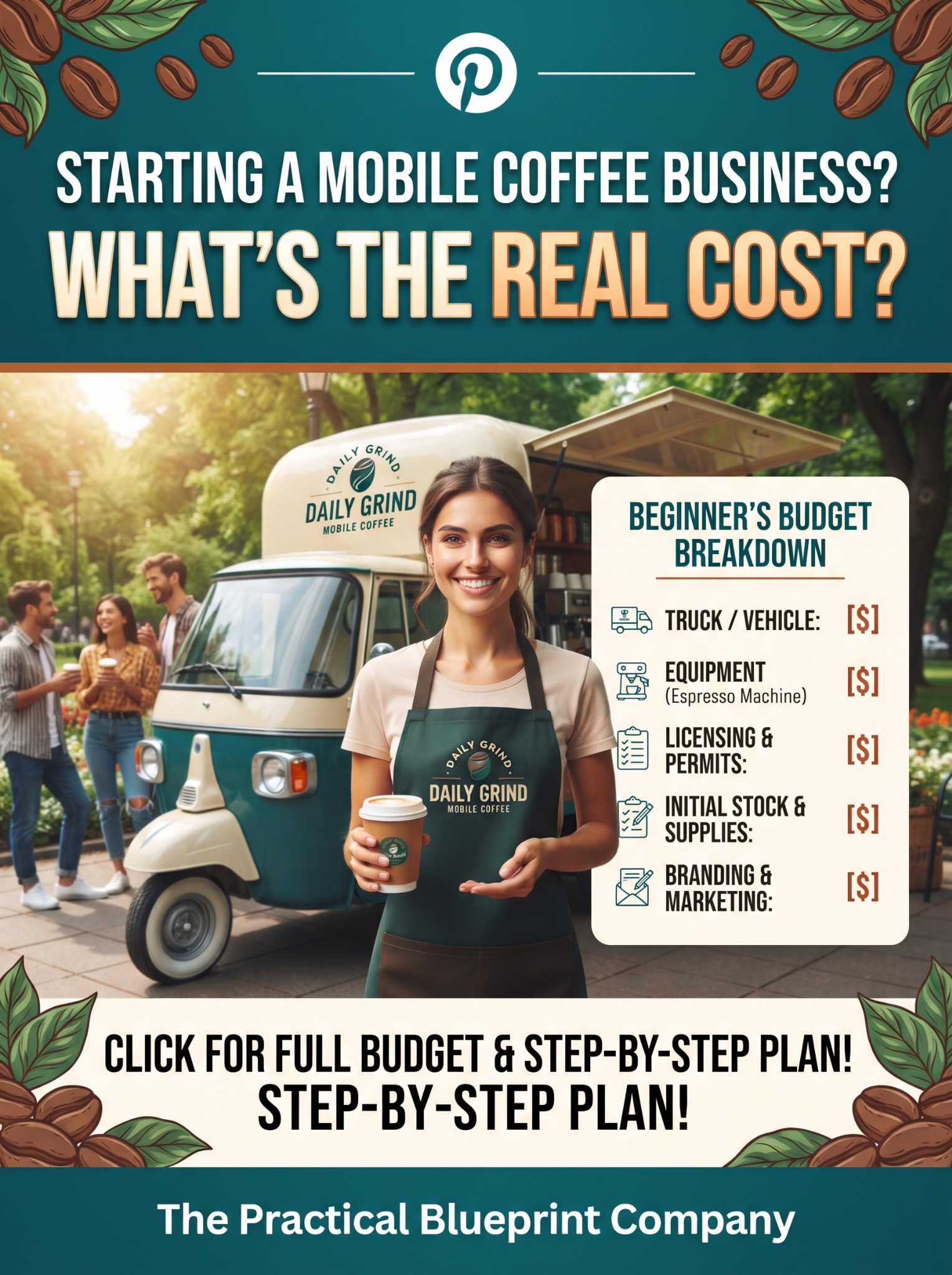
This beginner’s guide expands the five headings on our Pinterest pin: vehicle, equipment, licensing, initial stock and branding. We will also add the less photogenic essentials—transport, maintenance, pitch fees and cash reserves.
UK-focused planning guide, checked 24 October 2026. All worked budgets and sales examples below are illustrative assumptions, not supplier quotations, market averages or earnings forecasts. Readers outside the UK should use local prices and requirements.
1. Choose your trading model before setting a budget
Write down your intended first service: for example, “a compact espresso cart at weekend indoor markets” or “a coffee trailer for pre-booked private events”. That sentence determines what you need to buy.
- Portable cart or stall: investigate transport, secure overnight storage, weather protection and access to suitable facilities. The cart price is not the whole setup price.
- Coffee trailer: add a suitable towing vehicle if you do not have one, along with storage and the practicalities of positioning the unit.
- Converted van: consider the vehicle’s mechanical condition as well as its catering fit-out. A beautiful counter will not compensate for expensive repairs.
- Private-event service: budget for enquiries, travel, setup time and reliable service during a concentrated booking window.
Ask prospective venues about their facilities and requirements before ordering equipment. If the entire business depends on one pitch, check whether that opportunity is actually available. The planning approach in our one-page business-plan article can also help you define customers, costs and a manageable first offer; adapt its gardening examples to coffee.
2. Vehicle or cart: ask what the advertised price includes
Request an itemised quotation. Does the unit include the espresso machine, grinder, refrigeration, water arrangements, worktops and installation? Are delivery, VAT and any commissioning costs included? Used equipment may require servicing before you can rely on it.
A cart that costs less initially can become expensive if you then need to buy transport, rent storage and purchase separate weather protection. Conversely, an elaborate conversion may be unnecessary for a small indoor event service.
For any used vehicle or unit, arrange appropriate independent inspections and ask for maintenance records. Keep money available for faults discovered after purchase. Avoid counting equipment twice when it is already included in a package quotation.
3. Equipment: budget for the complete working setup
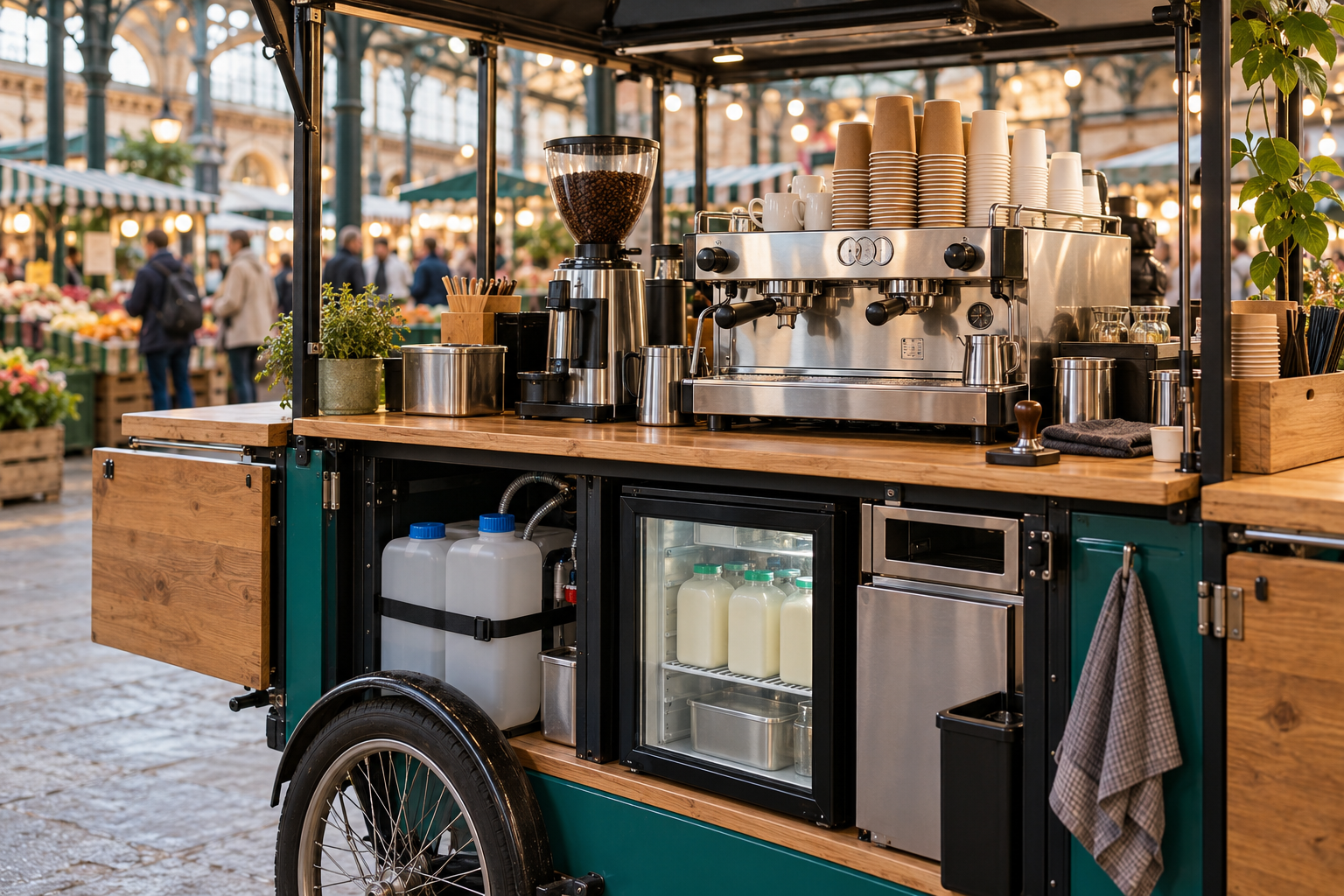
The espresso machine attracts attention, but the grinder, water treatment, refrigeration and cleaning arrangements deserve their own budget lines. Include jugs, scales, thermometers where needed, knock box, storage, payment equipment and the small items you will use repeatedly.
Check commercial suitability, servicing availability and the condition of second-hand equipment. Ask the supplier to confirm that your proposed power and water arrangements suit the equipment and your expected workload. A domestic appliance’s purchase price alone does not establish that it will be appropriate.
Do not guess the size of a battery, generator or electrical installation from a photograph. Obtain a competent assessment of the combined loads, starting requirements and safe installation. If a venue supplies power, confirm the connection and capacity rather than assuming any socket will do.
Start with a menu your setup can deliver consistently. Every additional drink or food line may add ingredients, storage, cleaning, allergen-management work and serving time.
4. Registration, permissions, insurance and training
These costs should be researched individually. There is no single national “coffee van permit price”. Under Food Standards Agency guidance for England, Wales and Northern Ireland, food business registration is free and should be completed at least 28 days before trading. Scotland has its own guidance and local-authority arrangements.
Registration does not automatically give permission to trade wherever you choose. GOV.UK advises checking street-trading requirements with the relevant council in England and Wales; fees, permitted locations and availability can vary. Confirm the position for your proposed sites, including private land, with the council and organiser.
Request insurance quotations that accurately describe the business, vehicle, equipment and events you intend to cover. Ask venues about their required cover. Allow for relevant training, food-safety procedures and any equipment inspections your setup needs. Obtain advice specific to your operation rather than treating a generic checklist as approval to trade.
5. Stock, packaging and branding: start with a focused offer
Opening stock includes beans, milk, any alternatives, tea, chocolate, cups, lids and cleaning consumables. Buying every syrup flavour can tie up cash before you know what customers want.
Base your first order on a cautious sales assumption and realistic replenishment times. Account for practice drinks, grinder adjustment, spills and unsold perishables. Keep stock purchasing separate from the equipment budget so it remains visible.
For branding, prioritise a readable menu, clear prices and a consistent business identity. Elaborate wrapping and premium printed packaging can wait until the service is proven. Keep a simple record of marketing spending and the enquiries it generates.
6. A worked beginner’s budget: £12,000 for a modest cart setup
This is a fictional planning exercise. It assumes suitable transport and secure storage already exist, the operator works alone, and agreed venue power is available. It does not include buying a road vehicle, a self-contained off-grid power installation, staff wages or personal living expenses. Each line represents cash to set aside; use VAT-inclusive quotes where VAT is payable and cannot be reclaimed.
| Budget item | Example allowance |
|---|---|
| Cart and basic fit-out, excluding equipment below | £2,500 |
| Commercial espresso machine and grinder | £3,000 |
| Water arrangements, filtration, washing and refrigeration | £1,000 |
| Small equipment, cleaning kit and payment setup | £400 |
| Opening stock and packaging | £400 |
| Insurance, relevant training, checks and local fee allowance | £700 |
| Basic branding and menu signage | £300 |
| Initial pitch bookings and transport allowance | £500 |
| Planned setup and opening expenditure | £8,800 |
| Contingency for unexpected setup costs | £1,200 |
| Separate working-capital reserve | £2,000 |
| Total example starting cash | £12,000 |
The £700 allowance is not a registration charge: registration itself is free under the guidance above. Replace that allowance with actual quotations and applicable fees. Likewise, the £2,000 reserve is a placeholder to test against your cash-flow plan, not a recommendation that this amount will cover every business.
If the equipment quotes exceed these allowances, increase the budget or revise the service. Do not force real costs into an attractive headline number. Our Mobile Coffee Business Complete Blueprint Bundle includes startup planning and financial tools to help organise those decisions.
7. Work out what it costs to keep trading
Separate expenses into costs that change with sales, costs attached to each trading day and fixed monthly commitments. Beans and cups rise with drinks sold. A pitch fee may be payable even during a quiet day. Storage, insurance payments and finance commitments may continue when you do not trade.
Build a month-by-month plan using realistic trading days, including cancellations and downtime. Include travel, cleaning, equipment servicing and administrative time. Keep your household budget alongside it: business turnover is not the amount available to pay yourself.

A simple daily sales reality check
Suppose a fictional operator sells drinks for £3.50 on average, with £1.10 of variable cost per drink, including ingredients, packaging, an allowance for waste and payment charges. That leaves £2.40 per drink to contribute towards other costs.
If allocated daily business costs are £96, selling 40 drinks covers those costs: £96 ÷ £2.40 = 40. To cover the same costs and provide an illustrative £120 for the owner’s work requires 90 drinks: (£96 + £120) ÷ £2.40 = 90.
This simplified example assumes no VAT liability and is before personal tax. It does not predict demand or recover the original investment automatically. Add relevant finance costs, equipment replacement and your full overheads when modelling your own business. Check whether your intended pitch could plausibly support the required sales.
8. A practical step-by-step spending plan
- Define your first offer. Choose the menu, trading format and customers.
- Investigate pitches. Check availability, facilities, fees and requirements.
- Get itemised quotations. Compare equipment, installation, delivery and servicing.
- Separate the money. Record setup costs, ongoing costs, contingency and household needs.
- Test a quieter month. Reduce expected sales and trading days to see what happens to cash.
- Delay optional spending. Upgrade appearance or menu breadth when evidence supports it.
If you are starting alongside employment, our article on planning a side hustle around a full-time job offers useful scheduling principles. Apply them to preparation, travel and cleaning as well as serving hours.
Frequently asked questions
Can I start a mobile coffee business for under £5,000?
It may be possible for a tightly limited service when suitable transport, facilities or equipment already exist. Do not assume that amount will buy a complete espresso van and fund its launch. Price the actual setup and retain cash for trading.
Is a coffee cart cheaper than a van?
It can have a lower purchase price, but compare the total including transport, storage and facilities. A cheap cart is not automatically the cheapest workable business.
Should I buy new or second-hand equipment?
Compare condition, servicing history, warranty terms, parts availability and installation costs. A lower purchase price is useful only if the equipment is suitable and reliable.
How much should I keep as a reserve?
Calculate what you would need during a realistic period of low sales or downtime. Keep setup contingency separate from working capital, and account for household costs separately. The right reserve depends on your commitments.
Does food business registration include a trading pitch?
No. Registering the business and securing permission to trade at a location are separate matters. Confirm both with the relevant authorities and venue before committing to a launch date.
Explore the blueprint collection for guides, planners and practical worksheets.